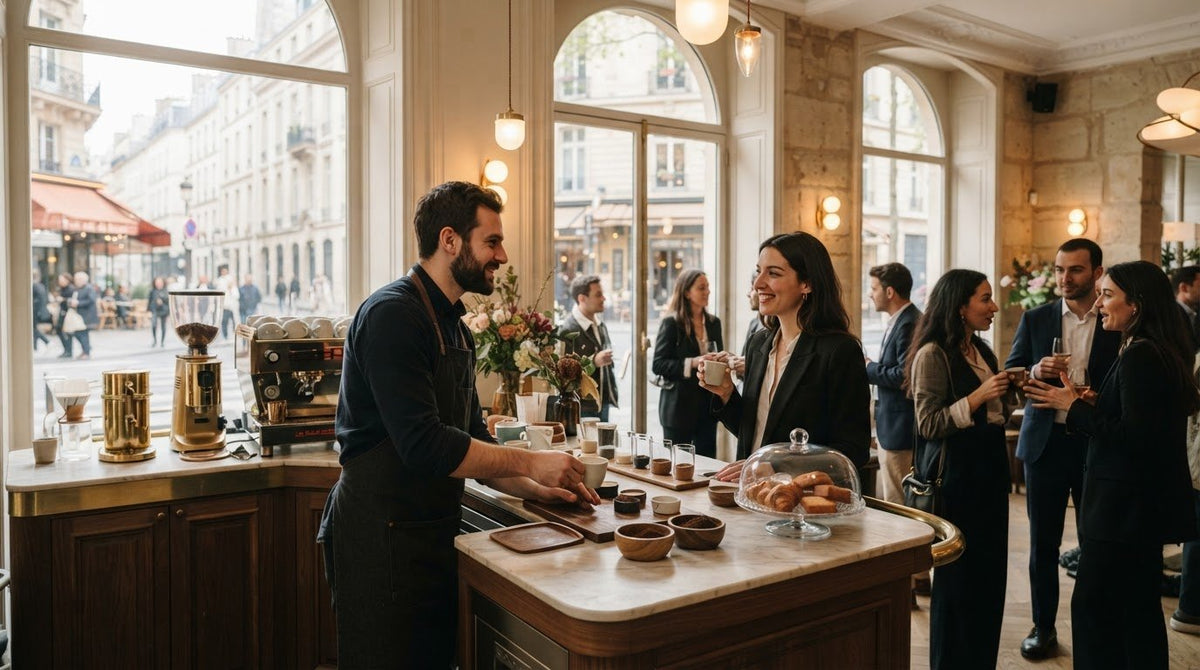
Street food stall in Paris: Boost your launch
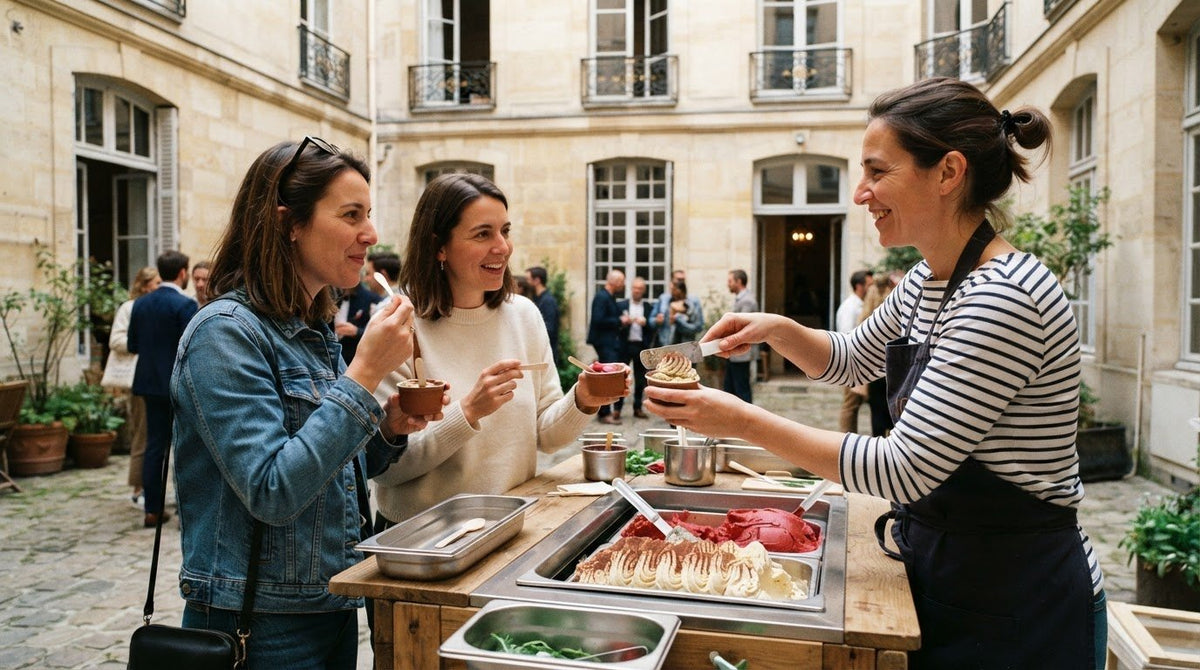
To generate press coverage for a food launch in Paris, the stand must tell the product's story as much as it lets people taste it. A street food stand for a product launch relies on a clear story, a suitable tasting location, and an immediately recognizable concept. On public roads, a kiosk requires the necessary permits; in a private location, a newsstand can be recreated exactly.
The press and visitors are more likely to remember a coherent experience than a simple product presentation. The decor, flavors, service style, and communication materials can create a unique narrative that reflects the brand's identity.
Discover how to define the offer, observe the local market, and build a budget suited to the chosen format without losing sight of the venue's constraints. Then prepare the communication, the launch, and the press coverage: from personalized invitations to ready-to-publish visuals, every detail can extend the product discovery.
Key takeaways
- Build a concept around the product's story, then harmonize the menu, decor, and tasting style.
- Observe the neighborhood's habits and peak times to adapt the offer to the visitors you want to attract.
- Structure your budget by category, from setup to communication, taking into account the format and operational needs.
- To attract the press, combine a distinctive narrative with a tasting, personalized invitations, and ready-to-publish visuals.
- Choose between a food truck, pop-up stand, and caterer depending on the location, desired mobility, and level of staging.
1. Defining the concept and street food offer
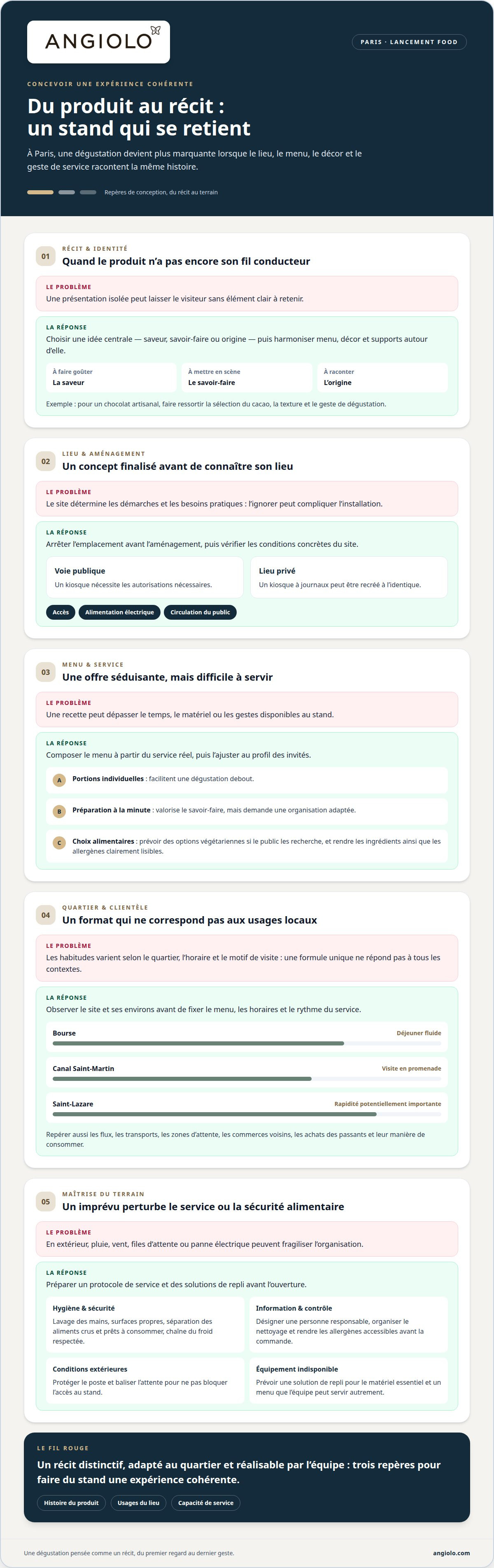
A street food stand turns tasting into an experience, centered around a product, a story, and immediate service. For a product launch, first define what the visitor should remember: a flavor, expertise, or origin. An artisanal chocolate launch can, for example, showcase the selection of cocoa, the texture, and the tasting gesture. The menu, decor, and materials must tell the same story.
In Paris, setting up a kiosk on public roads requires the necessary permits. A newsstand can also be recreated exactly in a private location for a product launch. Determine the site before finalizing the concept: private address or public space, access, electricity supply, and public flow guide the procedures and setup.
A concept can take the form of a simple counter, an editorial kiosk, or a pop-up bar in the evening. For this last option, combine tastings and music with a live musician and posters updated every hour. A visual edition inspired by a newspaper can extend the narrative: a personalized front page, headlines, and blurbs about the ingredients give guests a concrete thread.
To choose the menu, start with the service time, equipment, and necessary gestures. A recipe served in individual portions makes standing tasting easier; a made-to-order preparation highlights expertise more, but requires appropriate organization. Then adjust the selection to the guests' profile: provide vegetarian options if the public seeks them, and clearly communicate the ingredients and allergens present.
For hygiene and food safety, define a precise service protocol: hand washing, clean surfaces, separation of raw and ready-to-eat foods, and respect for the cold chain for the products concerned. Designate a person responsible for control, organize cleaning, and make allergen information accessible before ordering. These actions structure the stand's work throughout the event.
Outdoors, anticipate rain, wind, queues, and a power outage. Suitable protection limits the exposure of the station, while a marked waiting path prevents blocking access to the stand. Also plan a backup solution for essential equipment and choose a menu that the team can serve efficiently if the main equipment becomes unavailable. The concept depends as much on its staging as on its ability to adapt.
2. Analyzing the local market and clientele
In Paris, the same product does not meet the same uses in every neighborhood. An office clientele around Bourse often seeks a quick lunch, while an event near the Canal Saint-Martin can attract visitors out for a stroll. These examples provide clues without prejudging the profiles present: observe the habits around the chosen location before deciding on the menu, hours, and service format.
Start by observing the site. Identify the flows at different times, access to public transport, waiting areas, and neighboring businesses. Note what passersby buy, the duration of their break, and their way of consuming: sitting, standing, or on the move. In Saint-Lazare, for example, speed may matter more than a long tasting; in a cultural venue, discovery may take up more space.
Then map out nearby offers, without limiting yourself to similar stands. Note the cuisines offered, takeaway formats, vegetarian options, and menu presentation. A bakery, a café, and a market can meet the same break need, even with different products. This comparison helps find a distinctive place, for example with an artisanal recipe served in an easy-to-eat portion.
To clarify the clientele profile, talk to the people who frequent the site and with the event organizer. Ask what motivates their visit, what flavors attract them, and what constraints influence their choice. Concrete answers, such as "short break," "discovery of a local product," or "meatless option," clarify the composition of the offer. Also note recurring questions about ingredients and allergens.
A street food stand dedicated to a product launch benefits from adapting to the uses of the location rather than imposing a uniform path. In a food court, for example, some devices allow scanning a code at the table, gathering orders from several brands in one basket, then paying all at once. The orders are then distributed among the concerned stands. Analyze the effect of this path on discovery and pickup.
Finally, compare your observations with the promise of the launch. If the public comes for a culinary discovery, plan a tasting that clearly reveals the recipe. If the venue mainly hosts busy workers, favor a readable presentation and simple service. For a street food stand designed for a product launch, evaluate each choice according to three criteria: suitability for the neighborhood, interest to visitors, and the team's ability to keep up the pace.
3. Setup, operational, and communication budget
To build a useful budget, separate expenses by function rather than taking a global amount. A Parisian stand generally mobilizes several categories: decor design, installation, equipment, food, staff, transport, energy, and communication. For each category, indicate the need, the required quantity, and the duration of use. A reusable counter, for example, is not budgeted like a decoration designed for a single evening.
Start with the location and its setup. A kiosk installed in a private space may require specific decor, while an outdoor location requires planning for weather protection. Add the elements really necessary for service: work surfaces, lighting, refrigeration if the products require it, containers, and signage. The site plan allows you to identify access, connection, and storage constraints before validating these choices.
To estimate portions, staff, and equipment, start with the expected number of guests, the peak time, and the preparation time per order. Multiply the expected demand by the planned portions, then check if the team can serve them in the available time slot. A recipe requiring made-to-order finishing requires a different organization than a product prepared in advance.
- Portions: cross-reference invitations, responses received, and the planned tasting format.
- Team: distribute preparation, service, payment, and restocking according to the chosen path.
- Equipment: associate each step of the recipe with a piece of equipment, then add the necessary storage and cleaning solutions.
The operational budget must also include consumables, packaging, cleaning products, and the transport of elements to the site. For a launch in a Parisian courtyard, separately plan the delivery of the decor and that of the sensitive ingredients. This distinction makes visible the handling and storage needs, often forgotten during a first estimate.
Reserve a distinct line for communication. It can cover graphic creation, menu printing, invitations, presentation materials, and the preparation of visuals intended for the press. A personalized front page, for example, requires editorial work and production adapted to the chosen format. Also decide which elements will be digital, printed, or kept after the launch.
Finally, compare the projected budget with the actual flow of the event. Note the quantities consumed, the hours mobilized, and the unused equipment. If the service is concentrated over a short period, reallocate resources to preparation and restocking. If guests arrive gradually, favor a modular organization. This assessment will guide the setup and communication choices for a next edition, without automatically repeating every expense.
4. Communication and launch
To get press coverage, start with the product and its story, then choose a location where the tasting fits naturally. A recipe developed around a specific ingredient can guide the decor, the speech, and the tasting. Invite journalists and content creators with a concrete proposal: discover a flavor, meet expertise, or observe a preparation gesture. The concept must be understood even before the first bite.
At the launch, give the visitor an easy-to-remember narrative thread. A presentation inspired by a newspaper can bring together a personalized front page, an editorial, and blurbs dedicated to the ingredients and the recipe. The product then becomes the subject of a special edition, rather than a simple element placed on a counter. Make sure the tone of the texts corresponds to the brand's identity and remains readable on site.
To spark spontaneous reactions, offer a tasting in a high-traffic area. Place the stand visibly and keep the product accessible without obstructing circulation. A bite tasted on the way can spark an immediate conversation, especially if a member of the team briefly presents the ingredient or the manufacturing method. Collect the comments and questions heard: they reveal what the public really remembers.
Prepare the press materials before opening. A personalized send-out can present the concept, the product's story, and practical information, with a tasting in an original setting. For journalists, a special edition delivered to the office on the morning of the launch can contain the product. Add ready-to-publish visuals, accompanied by precise captions, to facilitate the pickup of the information.
If the event takes place in a food court, prepare a media kit useful to visitors and journalists. It can bring together photos free to use, a presentation of the location with its key figures, and the program of upcoming animations. Make sure the files and texts describe the same experience as that offered on site. An announced animation, for example, must be clearly locatable in the program.
After the launch, classify the coverage by medium and by theme: recipe, expertise, decor, or tasting experience. Keep the published articles, the journalists' questions, and the reactions collected at the stand. This assessment helps identify the most repeated messages and refine a next edition. It also allows you to extend the communication with coherent content, rather than repeating the initial announcement.
5. How to choose between a food truck, pop-up stand, and street food caterer?
The suitable format depends on the location, the guests' path, and the desired staging. In Paris, a launch in a private courtyard does not offer the same possibilities as an indoor reception. Compare the necessary mobility, the available equipment, the pace of service, and the place given to decor before choosing a solution.
The food truck is suitable when the vehicle can access the site and the service from its counter fits into the event. It brings a visible presence, useful for an outdoor launch or an animation open to passersby. On the other hand, a narrow access, a courtyard difficult to maneuver, or the absence of a suitable parking area can make this format impractical.
The pop-up stand allows you to design a decor around the product. In a Parisian gallery, a newsstand-inspired kiosk can combine presentation, tasting, and editorial materials. This format adapts to an indoor or private space, but requires thinking about installation, circulation, storage, and connections. It is particularly suitable when the image of the launch must be read in a few moments.
The street food catering service responds rather to events where the organizer wants to integrate a culinary offer into an already established flow. For a press reception, for example, the service can accompany a speech then a tasting, without making the vehicle or the kiosk the center of the scenography. This choice also suits when the configuration of the location limits the installation of an autonomous structure.
To compare the formats, examine these criteria together:
- Location: access to the site, available space, and installation constraints.
- Experience: visibility of the product, interaction with guests, and place of decor.
- Service: preparation on site, distribution pace, and team needs.
- Mobility: necessity to move the setup or serve in several spaces.
The food truck favors an autonomous and mobile presence. The pop-up stand offers more visual freedom, while the caterer integrates more easily into the program of a reception. For a launch in a private location, the formats can also be combined: a decorated counter for the tasting and a service organized around the highlights.
Before deciding, draw the path of a guest, from their arrival to the tasting. Identify where they discover the product, where they wait, and where they exchange with the team. If the truck blocks the entrance or if the stand creates a congestion point, the plan reveals the problem before the event. The most suitable format highlights the recipe and its story without complicating travel.
Angiolo: Artisanal ice cream and sorbet pots
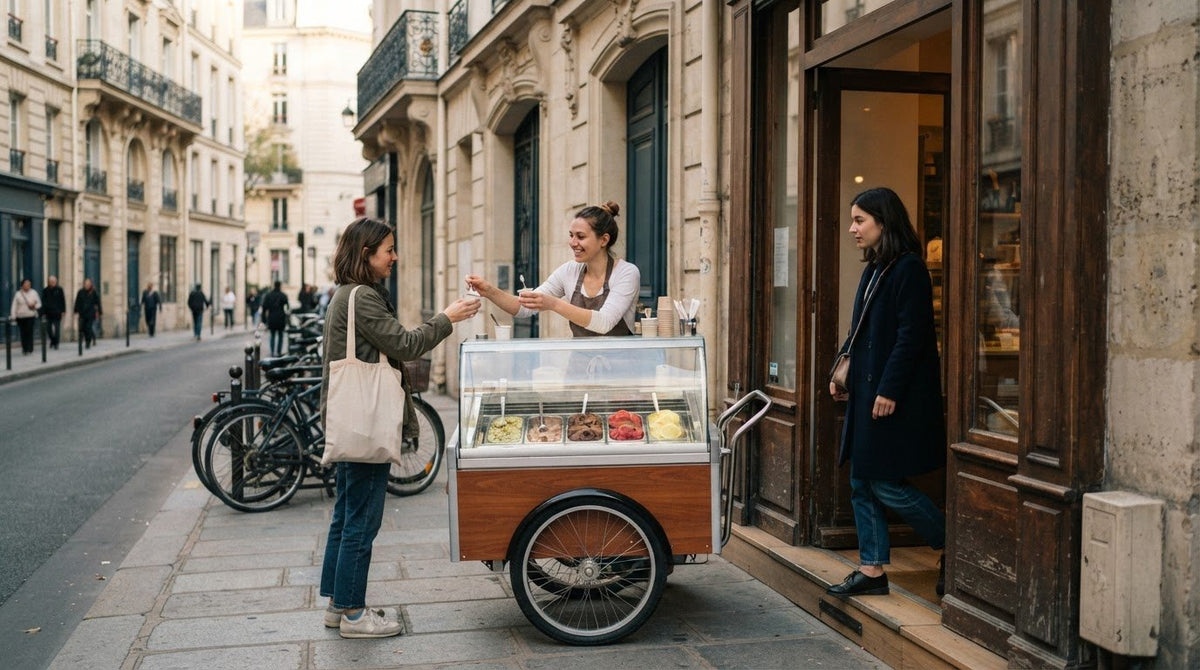
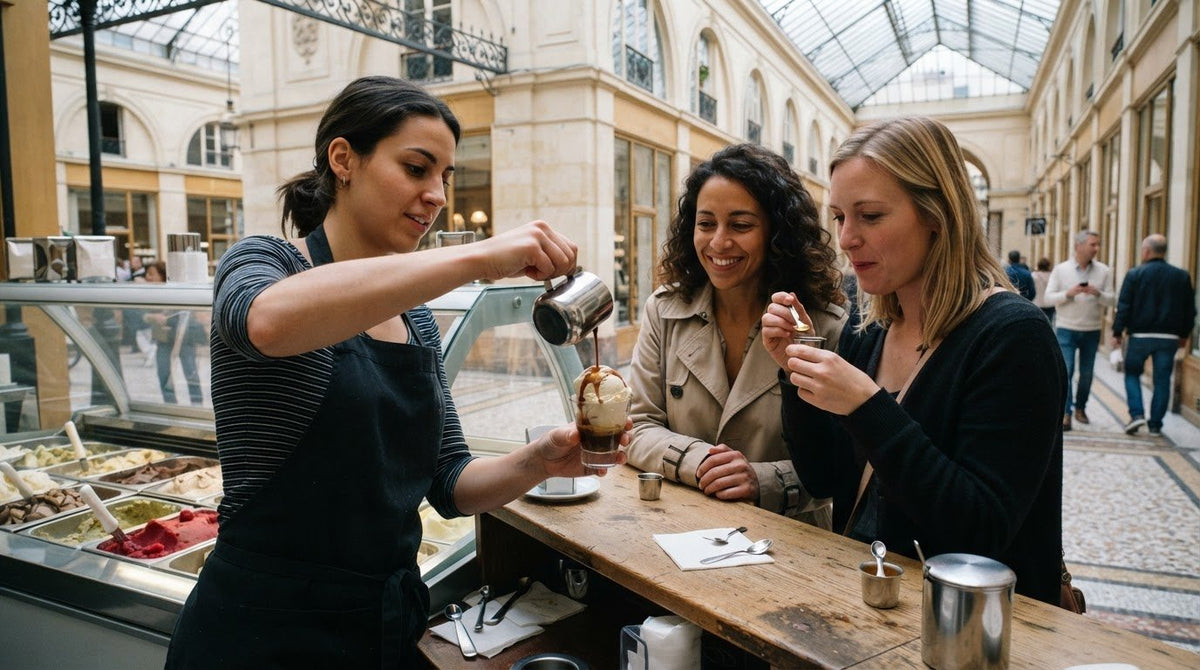
Angiolo accompanies launches where an artisanal tasting brings a sensory dimension to the welcome of guests. For a pop-up stand or a reception, its artisanal ice cream and sorbet pots compose a gourmet proposal, while an animation with an ice cream cart places the service at the heart of the experience. Its catering service specialized in frozen desserts can also integrate into the flow of the launch.
This approach suits when the launched product matches a fresh and refined break, or when a frozen dessert completes the tasting path. Choose the format according to the location, the desired atmosphere, and the way guests will discover the offer.
To discuss your event, contact Angiolo.
Give a lasting signature to your launch
The next step is to choose the detail that your guests will spontaneously associate with your brand: a texture, a scent, a serving gesture, or an encounter with the artisan. For a product launch with a street food stand, this signature must remain true to your universe while sparking curiosity from the very first tasting.
Imagine yourself on the day of the launch. What memory do you want to leave after the final exchange, and what feeling will prolong the experience beyond the stand? This intention helps refine the menu, the scenography, and the pace of the welcome, without adding effects that would distract attention from the product.
Angiolo can enhance the gourmet dimension of your event. Discuss your launch with Angiolo and imagine an experience worthy of your creation. A well-thought-out idea, a masterful gesture, a lingering flavor: that is a beautiful way to open the next chapter.
Frequently Asked Questions
How to get press coverage for a food launch?
To interest the press, present a precise editorial angle, distinct from the mere commercial announcement. A unique origin, expertise, or combination of flavors can fuel this narrative. Personalize each contact according to the media outlet, then facilitate the writing process with accurate information and suitable visuals. After the event, send a concise report and useful complementary elements to the journalists.
How to organize a food product launch?
Start by defining the launch objective: introduce a recipe, gather reactions, or present a new brand. Then, appoint a person responsible for the proceedings, from the welcome to the end of service. For a drink tasting, for example, prepare a presentation sheet distinct from the spoken pitch. A prior trial with the team allows you to identify misunderstandings and adjust the guests' journey.
Why launch a product in a kiosk or an everyday location?
A familiar location makes the discovery less ceremonial and can bring the product closer to actual consumption habits. A kiosk recreated in a private courtyard, for example, creates a contrast between a recognizable setting and a culinary novelty. The setting can also provide a conversation starter and memorable visual cues. However, choose it based on the product's story, not just its photographic appeal.
What is a street food stand for a product launch?
It is a presentation and tasting space designed around a food product, with service adapted for immediate consumption. It can be a mobile counter or a temporary installation in a private location. To present a new sauce, for example, offer it with a simple accompaniment that reveals its taste, rather than a complex preparation that would distract attention from its texture and aromas.
What budget to plan for a street food stand during a product launch in France?
The budget depends on the location, duration, number of guests, and service format. Establish distinct line items for installation, equipment, ingredients, staff, transport, and communication. A tasting in an already equipped space does not require the same resources as a kiosk to be fitted out. Compare each expense to its usefulness for the experience, then keep a margin for unforeseen logistical needs.
What steps to organize a street food stand during a product launch?
First, set the objective and the audience, then select the location according to its access and constraints. Next, finalize the menu, the tasting journey, and the material needs. Clearly assign the roles of preparation, welcome, and service. Before opening, rehearse the entire process, from restocking to cleanup. After the launch, record the guests' feedback and operational difficulties to improve the next event.
What procedures and authorizations are required to set up a street food stand in France?
In Paris, setting up a kiosk on a public road requires the necessary authorizations. First, determine whether the location is public or private, then check access, electricity, and public flow to guide the procedures and layout.