Artisanal ice cream: the secrets of traditional production
What if the secret to a successful ice cream relied less on a recipe than on the balance between its ingredients, the handling of temperature, and the craft of the ice cream maker? Behind the search for "traditional handmade ice cream," a question keeps coming up: how can one distinguish true expertise from a mere promise in a shop window? The doubt is legitimate. The word "handmade" does not, on its own, reveal the choices that give an ice cream its character.
To understand what is at stake, follow the preparation step by step. The choice of ingredients, the balance of the recipe, the incorporation of air, and temperature control all influence density, creaminess, and the expression of flavors. Slight variations can transform the tasting experience: a more supple texture, a different melt, or a clearer flavor.
In this article, you will discover this journey, from raw material to service, as well as concrete clues to look for at a Parisian ice cream shop. Angiolo, founded by a Sicilian master ice cream maker and two passionate entrepreneurs, illustrates the dialogue between the Italian gelato heritage and French gastronomic sensitivity. This origin, however, is not enough to describe every step of the manufacturing process. It is time for the techniques, the materials, and the precision that shape the ice cream.
Key Points
- Traditional handmade ice cream relies on preparation choices and know-how, but the word "handmade" is not enough to guarantee quality.
- Identify the major steps, from preparation to churning, keeping in mind that they vary according to the recipes and the artisans.
- Relate the nature of the ingredients and the balance of the preparation to density, creaminess, and the expression of flavors.
- When tasting, observe the texture, the melt, and the consistency of the flavors. A vivid color or a neat presentation does not, in itself, prove handmade production.
- Discover how the Sicilian heritage of Angiolo's master ice cream maker fits into a dialogue between the gelato tradition and Parisian sensitivity.
Traditional handmade ice cream production: what expertise really entails
Handmade ice cream is often described in a few words: selected ingredients, the maker's craft, a "homemade" recipe. But these terms do not tell the whole story. To understand traditional handmade ice cream production, look beyond the label and focus on the decisions that shape the result.
The traditional production of an ice cream is a process where the maker selects and balances the ingredients, then adapts the preparation and cooling to the desired result. This definition describes an approach, not an automatic guarantee of quality. The nature of the raw materials matters, as does their formulation, their treatment, and the way their flavors express themselves during tasting.
What does it mean to make ice cream in a handmade way?
Expertise manifests itself in concrete choices: which ingredients to combine, how to preserve their character, and what balance to aim for between sweetness, aromatic intensity, and texture. An ice cream is not just a list of components. It is a preparation whose elements must work together.
Large-scale production meets other organizational and volume constraints, without that being enough to judge a product's quality. Conversely, the word "handmade" does not, on its own, allow one to know the method used, the origin of the ingredients, or their degree of processing. For an initial overview of ice cream, its history, and its main categories, an encyclopedic resource can provide benchmarks, without replacing the ice cream maker's explanations regarding their production.
Gelato tradition and French gastronomic sensitivity
The Italian gelato tradition evokes a heritage and a culture of ice cream, not a single method followed identically by all artisans. Recipes, techniques, and formulation choices can vary. Tradition and contemporary creation are therefore not opposed: an ancient inspiration can nourish a current expression, without it being necessary to claim a precise recipe.
In Paris, Angiolo is part of this dialogue. The house was founded by a Sicilian master ice cream maker and two passionate entrepreneurs, and highlights the encounter between the Italian gelato heritage and French gastronomic refinement. This presentation sheds light on the house's world, but does not allow one to deduce the exact steps applied to each preparation. Ingredients, cold, texture, then tasting: it is through this thread that production choices take on their full meaning.
From preparation to churning: the steps that build a handmade ice cream
Ice cream takes shape in stages. The preparation must first be sufficiently homogeneous for its components to be distributed evenly. Depending on the recipe, it can then be heated, cooled, left to rest, and then churned. This journey provides benchmarks to understand traditional handmade ice cream, but it does not constitute a single method. Choices vary according to the preparation and should not be attributed to an ice cream maker without confirmation.
Preparing the base and mastering temperatures
The balance of the preparation dictates its transformation in the cold. A homogeneous base helps to obtain a regular texture and to distribute flavors and components. The formulation—that is, how ingredients are measured and associated—must therefore be thought out according to the desired result.
Pasteurization is a general process that consists of heating a preparation and then cooling it according to parameters adapted to the product. It cannot be presumed for all recipes. Similarly, cooling followed by maturation—a resting period that can help the base stabilize before churning—is part of some journeys, but should not be automatically attributed to every ice cream maker. For Angiolo, these precise steps remain to be confirmed.
Churning, overrun, and texture formation
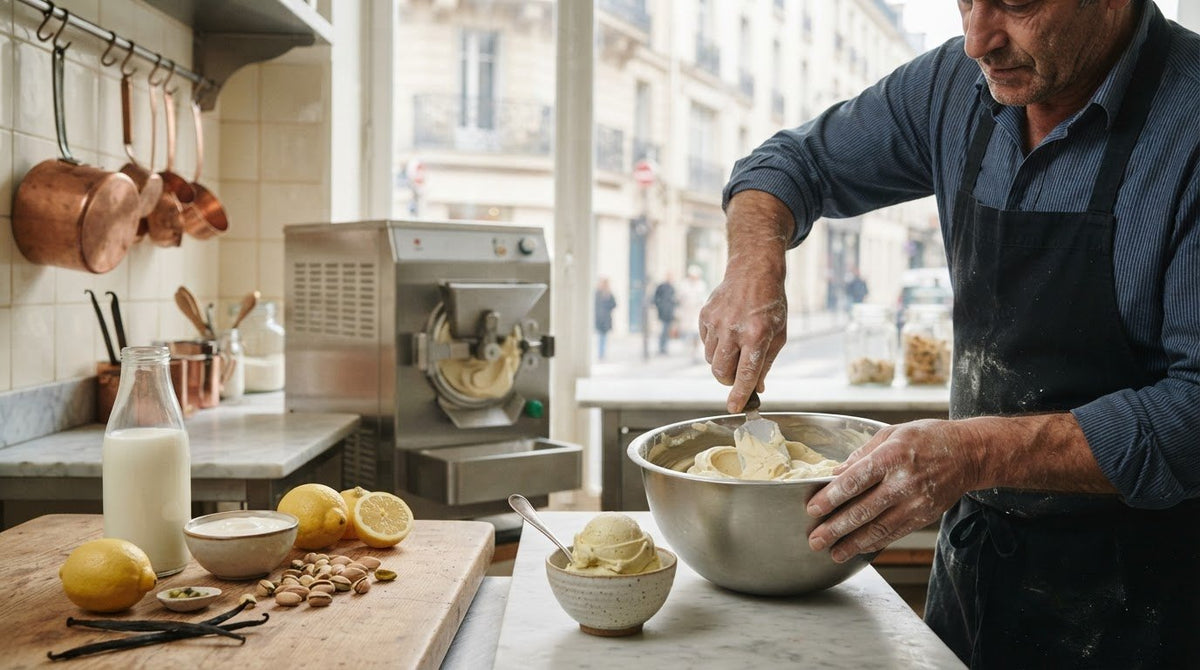
Churning refers to the continuous mixing of the preparation during its cooling. This movement helps form a fine and regular texture, while the cold progressively transforms the base into ice cream. The cold firms up the preparation, while the mixing distributes the air and helps shape a texture that is more or less dense.
Overrun refers to the amount of air incorporated during churning. This incorporation influences the density and the mouthfeel: a preparation containing more air may seem lighter, while a denser ice cream offers a different sensation. No level can be deduced from the word "handmade" alone; it depends on the recipe and the work performed.
The texture obtained during production is not to be confused with the serving temperature, that is, the temperature at which the ice cream is presented for tasting. This influences its suppleness and the perception of aromas, without revealing how the product was manufactured on its own. To discover the ice creams and frozen desserts offered by Angiolo in Paris, explore the house's universe.
Ingredients, balance, and texture: what is revealed during tasting
Tasting reveals the harmony between three dimensions: the quality of the raw materials, the formulation—that is, how ingredients are combined—and the manufacturing process. A ripe fruit can offer a frank fragrance, but its expression also depends on the balance of the preparation and the texture obtained. Traditional handmade ice cream is judged by the consistency of the whole, not by a single ingredient or an isolated argument.
Ice cream or sorbet: two distinct balances
Ice cream generally relies on a dairy base, while sorbet places the fruit more in the foreground and does not rely on the same structure. This difference influences the mouthfeel: one may seem rounder, the other may leave a more vivid and fruity impression. These are tendencies, not universal recipes. The proportion of ingredients and the formulation vary according to the creations.
At an ice cream shop, ask what characterizes a specific recipe rather than deducing the composition from its name alone. The information available does not allow one to attribute a particular formulation to Angiolo's ice creams or sorbets. Transparency regarding ingredients and the care taken in their balance remain useful benchmarks for appreciating the approach.
Creaminess, melt, and aromatic persistence
During tasting, observe how the ice cream holds on the spoon, then melts on the tongue. A pleasant creaminess is not necessarily synonymous with heaviness: the texture can be supple while still allowing the aromas to express themselves distinctly. Also evaluate the persistence in the mouth. Does the main taste remain clear, or is it overshadowed by an overly sweet or fatty sensation?
The term clean finish refers to a clean mouthfeel after tasting, without residual fat or artificial aftertaste. It is a sensory clue, not sufficient proof of handmade production. To guide your tasting, ask yourself three questions:
- Does the flavor clearly evoke the announced ingredient?
- Does the texture appear regular and pleasant as the ice cream melts?
- Do the aromas persist without masking the other sensations?
Finally, storage and serving temperature modify the suppleness of the ice cream and the perception of its fragrances. An ice cream that is too cold may seem firmer and deliver its aromas with less intensity; a more supple texture often makes them more perceptible. Therefore, interpret the tasting in its context, without confusing a punctual sensation with the overall quality of the work.

How to recognize the care of traditional production without relying on slogans
An elegant display window catches the eye, but it does not tell the whole story of production. To appreciate the handmade care, cross-reference several clues: the clarity of the taste, the regularity of the texture, and the consistency between the announced aroma and the mouthfeel. No single sign is enough. Their concordance, supplemented by the ice cream maker's explanations, helps to better understand their approach.
Which clues to observe in the display window and during tasting?
Start by tasting without stopping at the appearance. A well-defined flavor clearly evokes its main ingredient; the texture accompanies this expression without crushing it. Also observe the melt and the final sensation: a very vivid color, a perfectly smooth shape, or a neat presentation do not, by themselves, prove handmade production.
The method of presentation can inform you about how the preparations are protected. Pozzetti are covered stainless steel containers that limit the ice cream's exposure to light and air. This is a sign of storage and presentation, not sufficient proof of quality or method. Equipment does not replace tasting or information about production.
What questions to ask an ice cream maker in Paris?
A precise question, asked with curiosity, often opens up a more useful exchange than a request for a recipe. You can ask:
- How do you choose the ingredients and what information can you share about their origin?
- What preparation steps are specific to this ice cream or sorbet?
- How are the products stored before service?
- What exactly does the mention of HACCP cover in your approach?
These questions focus on benchmarks accessible to the customer, without requiring the revelation of a confidential formulation. The answer can specify the choices of raw materials, the techniques, or the storage precautions. If a detail varies according to the recipe, the ice cream maker can also clarify it. To evaluate a traditional handmade ice cream, look for the consistency between what is explained and what you perceive in the taste, rather than a general promise.
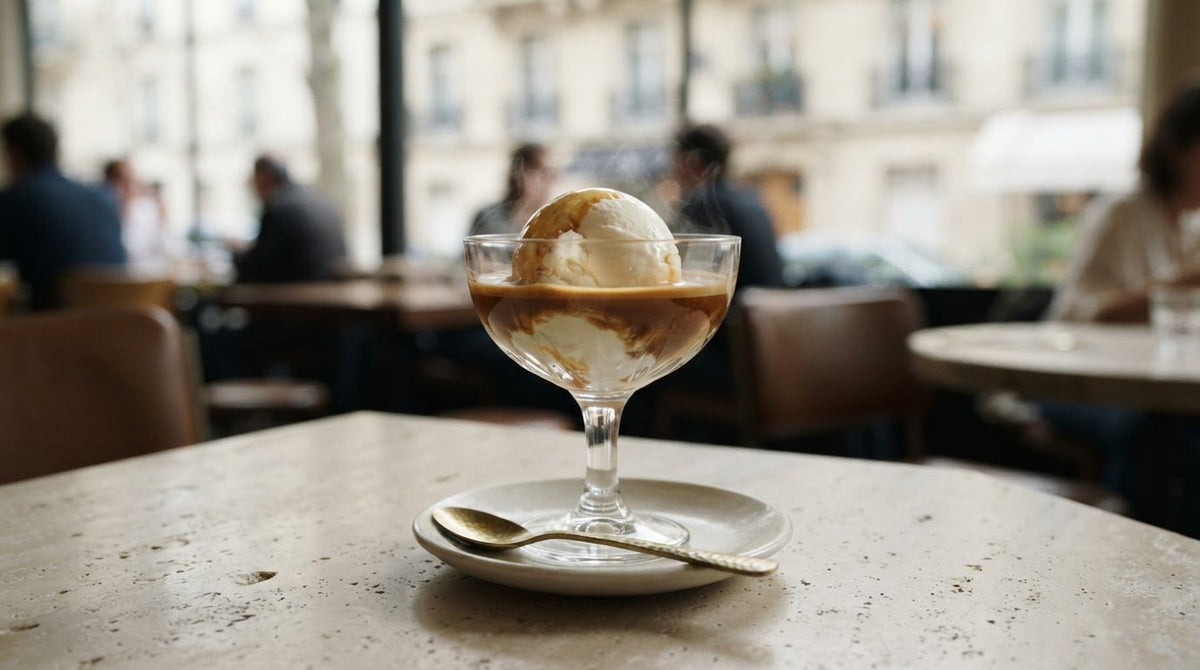
To discover the handmade ice creams and sorbets by Angiolo in Paris, consult the house's offerings. You will also find frozen desserts, including frozen tiramisu and espresso affogato. The details of production processes and the exact scope of a reference to HACCP should be verified directly with the house.
Traditional production at Angiolo: Sicilian heritage and Parisian sensitivity
In Paris, handmade ice cream can carry several sensibilities: the heritage of a trade, a culture of taste, and an attention to textures. Angiolo is part of this dialogue. The house was founded by a Sicilian master ice cream maker and two passionate entrepreneurs. This origin sheds light on Angiolo's world, without being enough to describe the recipes or the precise production techniques.
A Sicilian ice cream maker's heritage in the Parisian landscape
Sicily is associated with a gelato tradition that inspires many artisans, but it does not refer to a single method. A journey, a recipe, or a process cannot be deduced from the ice cream maker's origin alone. At Angiolo, the Italian heritage is presented in dialogue with French gastronomic refinement: an encounter between the culture of gelato, the demand for flavors, and the search for a balance in the mouth.
Paris constitutes the setting for this expression. Tasting allows one to appreciate the nuances, without it being necessary to compare the house to other artisans or to imagine unconfirmed practices. To better understand what distinguishes a handmade ice cream maker, observe the ice creams and sorbets offered, then focus on the ingredients and the choices that the team can explain. Angiolo offers tubs of handmade ice cream and sorbet, as well as frozen desserts. Production details remain to be confirmed with the house.
Extend the discovery of Angiolo handmade ice creams
Handmade ice cream tubs offer a way to discover different preparations, without prejudging their composition. The range also includes frozen tiramisus and espresso affogatos. For an event in Paris, Angiolo offers entertainment with an ice cream cart and a catering service specializing in frozen desserts. These formats allow one to discover the house's creations in different contexts.
Traditional handmade ice cream takes on its full meaning when heritage meets precise attention to ingredients, texture, and tasting. To discover Angiolo's handmade frozen creations, explore Angiolo's handmade frozen creations.
It is your turn to savor the expertise, one spoonful at a time
Traditional handmade ice cream is understood through a set of choices: selection of ingredients, balance of the preparation, control of the cold, and texture revealed during tasting. The term "handmade" is not enough to explain everything. The taste, the melt, and the consistency of the aromas offer benchmarks that the ice cream maker's answers can clarify.
In Paris, Angiolo brings the Italian gelato heritage into dialogue with French refinement. The house was founded by a Sicilian master ice cream maker and two passionate entrepreneurs. It highlights its handmade creations and quality ingredients, without this allowing one to presume every manufacturing detail.
Extend the discovery through tasting. Discover Angiolo's handmade frozen creations, including its ice cream and sorbet tubs, its frozen tiramisu, and its espresso affogato. Take the time to appreciate their flavors, texture, and balance.
Frequently asked questions about handmade ice cream production
What is an ice cream made in a traditional handmade way?
An ice cream made in a traditional handmade way results from preparation choices made by an ice cream maker, from the balance of ingredients to the handling of the cold. The quality also depends on the nature of the raw materials and the precision of the techniques. The term "handmade" does not alone guarantee a texture or a flavor. Observe the consistency of the aromas and ask the ice cream maker what they can explain about their approach.
How does the traditional production of a handmade ice cream take place?
Preparation begins with the assembly and balancing of the ingredients. Depending on the recipe, it may then be heated, cooled, and left to rest before churning, which stirs the mixture while cooling it. These steps contribute to the final texture, but their order and inclusion vary by recipe. They cannot be attributed to a specific ice cream maker, such as Angiolo, without confirmation from the house.
What is the difference between artisanal ice cream and gelato?
“Artisanal ice cream” describes a production method, while “gelato” refers to an Italian tradition of ice cream with varied styles and recipes. Gelato is often associated with a dense texture and pronounced flavors, but these characteristics do not define every preparation. In Paris, Angiolo evokes this heritage through its head ice cream maker’s Sicilian roots, though this alone does not reveal their recipes.
Why does churning influence the texture of ice cream?
Churning stirs the mixture while it cools. The movement helps distribute air and form a uniform texture, while the cold gradually firms the base. The duration and method of churning therefore influence density and mouthfeel. The result also depends on the formulation: churning alone cannot guarantee the smoothness or aromatic intensity of an ice cream.
Can one recognize artisanal ice cream by its color or texture?
No, neither an intense color nor a particular texture proves artisanal production on its own. Color can depend on the ingredients and the recipe; texture, on the process, storage, and temperature at the time of tasting. Instead, taste for clarity of flavor, consistency of texture, and coherence of sensations, then ask the ice cream maker for details regarding their production choices.
What is overrun in ice cream making?
Overrun refers to the amount of air incorporated into the mixture during churning. It influences density: ice cream containing more air may seem lighter, while a denser preparation provides a different mouthfeel. This technical term does not, in isolation, allow one to judge quality. The balance of the recipe, mastery of cooling, and tasting also count in the appreciation of the result.
At what temperature should artisanal ice cream be served to appreciate its aromas?
The serving temperature influences the suppleness of the ice cream and the perception of its aromas. For gelato, it is generally between -12°C and -14°C, but the appropriate temperature depends on the preparation and its storage conditions. If too cold, ice cream may seem firm and reveal its flavors less clearly. Let it soften slightly and enjoy it when it becomes easy to eat.