How to Choose an Artisan Ice Cream Maker: The Guide to Icy Excellence
What if the vibrantly colored mountain of ice you admire in the display case was merely an industrial mirage? Behind the artisanal label, too often misused, sometimes lie powdered preparations and excessive air that betray the nobility of the craft. You've probably already felt that bitter disappointment when faced with an overly crystallized texture or an artificial-tasting flavor. It's time to redefine your standards and rediscover the pleasure of an authentic creation.
This guide teaches you precisely how to choose an artisanal ice cream maker by adopting the perspective of a master creator. We promise to transform your next tasting into a high-precision culinary experience, far from soulless imitations. Purity of raw materials. Balance of flavors. Absolute technical mastery. You will learn to visually decipher an ice cream tub, rigorously analyze the composition of sorbets, and savor every nuance like a true taste professional. Immerse yourself in the world of refined ice cream, where traditional craftsmanship meets contemporary elegance to offer unparalleled sensory distinction.
Key Takeaways
- Identify true artisanal production by distinguishing the use of raw materials from simple industrial mix assemblies.
- Learn how to choose an artisanal ice cream maker through precise visual cues, such as the sober chromatic palette of flavors and the use of covered display cases.
- Master the art of sensory tasting by evaluating the creaminess of the texture and the precise thermal balance of an exceptional creation.
- Discover why the choice of short-supply-chain ingredients and respect for seasons are the undeniable signatures of a visionary master ice cream maker.
- Locate prestigious addresses, particularly in Saint-Germain-des-Prés, where ancestral know-how blends with an uncompromising demand for quality.
Recognizing a true artisanal ice cream maker: Beyond the label
Excellence isn't just displayed on a storefront; it's proven with every bite. To understand how to choose an artisanal ice cream maker, you must first uncover a title that is often misused. In France, the appellation "Artisan" is protected. It requires holding a CAP or BEP diploma or having three years of validated experience. This is a reassuring legal foundation. However, the mention "homemade ice cream" can sometimes mask a less noble reality. It guarantees on-site production but does not prohibit the use of pre-mixed industrial bases that only need rehydration. The true artisan, on the other hand, is a recipe creator. They start with raw materials: fresh milk, whole cream, seasonal fruits, and rigorously weighed sugars.
Transparency is the first sign of distinction. A master ice cream maker who has nothing to hide often allows a glimpse into their laboratory. It's there, among the stainless steel tanks and churns, that the magic happens. This openness to the backstage testifies to a total commitment to quality and a legitimate pride in meticulous craftsmanship.
The manufacturing process: From raw material to tub
The creation of exceptional ice cream relies on absolute technical mastery. It all begins with the pasteurization of the dairy bases. This crucial step is not limited to hygiene. It allows proteins to bind and aromas to fully develop. Then comes churning, the moment of truth where the liquid mixture becomes solid. This is where one observes the difference between craftsmanship and industrial profit. Industry often injects up to 50% air into its products to increase volume. The artisan, on the contrary, limits this aeration to favor density and intensity. This is also a major criterion for grasping the difference between gelato and ice cream: a richer, less airy texture that exalts the purity of the components. The ice cream chef adjusts their parameters according to the humidity of the fruits or the fat content of the cream, ensuring perfect balance.
Artisan vs. Industrial: The Ingredient Battle
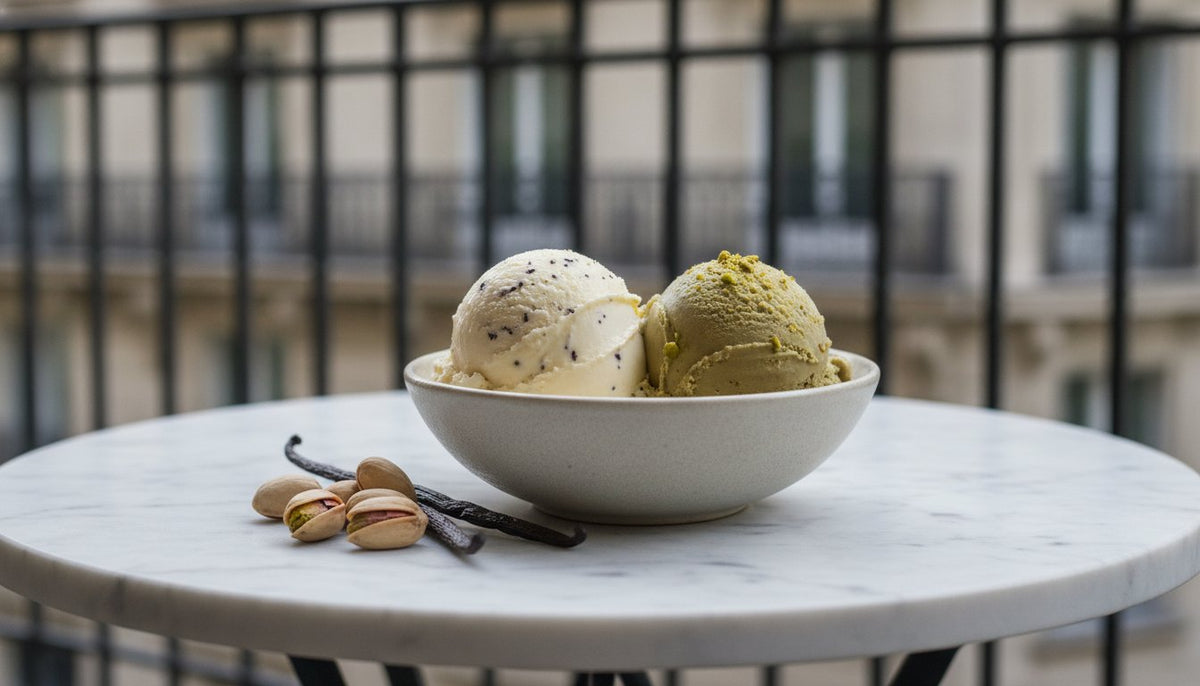
Luxury lies in the purity of its components. An excellent ice cream maker systematically bans hydrogenated vegetable fats, such as palm or coconut oil, which saturate the palate and mask flavors. Synthetic aromas and suspiciously colored dyes are prohibited in favor of the nobility of the product. They seek Bourbon vanilla pods, Bronte pistachios, or Sicilian lemons. For texture, the artisan prefers natural stabilizers such as carob seed flour or guar gum. These ingredients respect health and offer an authentic creaminess. By choosing an artisan who composes their own bases, you opt for a unique flavor signature, far from the standardized tastes of mass production.
The 3 foolproof visual clues to choose your ice cream maker
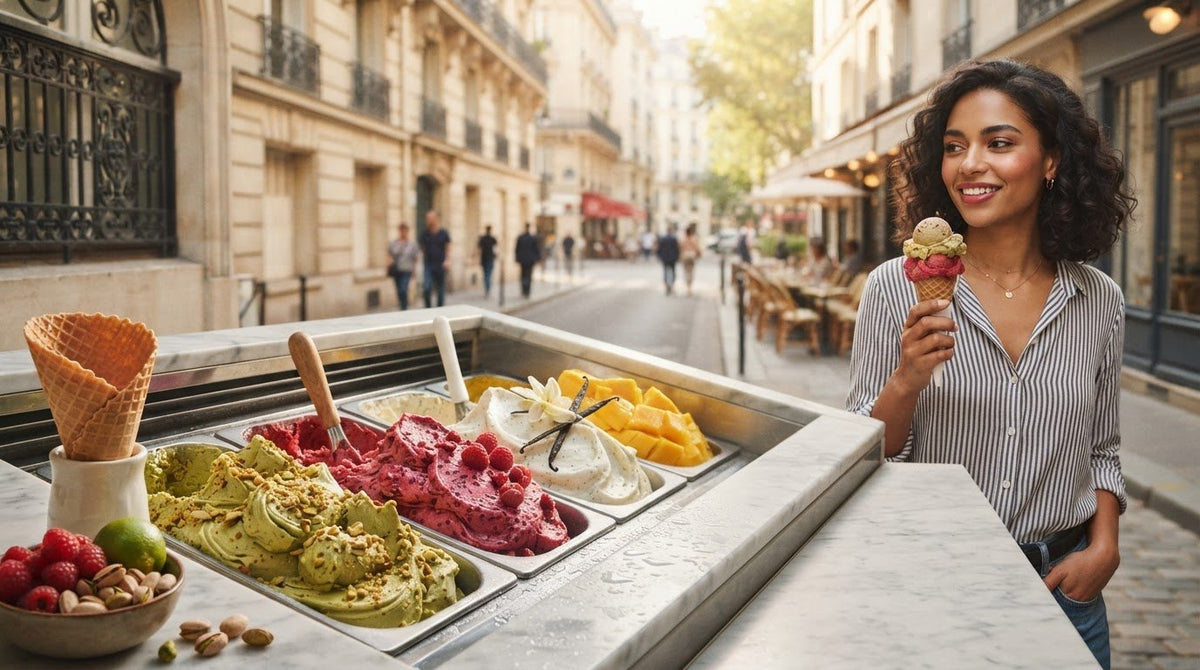
Even before the first spoonful touches your lips, your eyes have already rendered their verdict. Understanding how to choose an artisanal ice cream maker begins with a clinical observation of the display case. A display that tries to entice with excess often hides technical shortcomings. Conversely, simplicity is the hallmark of the greatest masters. First, observe the structure: ice cream that forms dizzying mountains well above the cold tub is an alarm signal. To maintain such an architecture without melting at room temperature, the product must be saturated with vegetable fats and chemical emulsifiers. True craftsmanship respects the laws of physics. The ice cream remains neatly confined to its cold zone, where its texture remains stable and pure.
The truth about natural colors
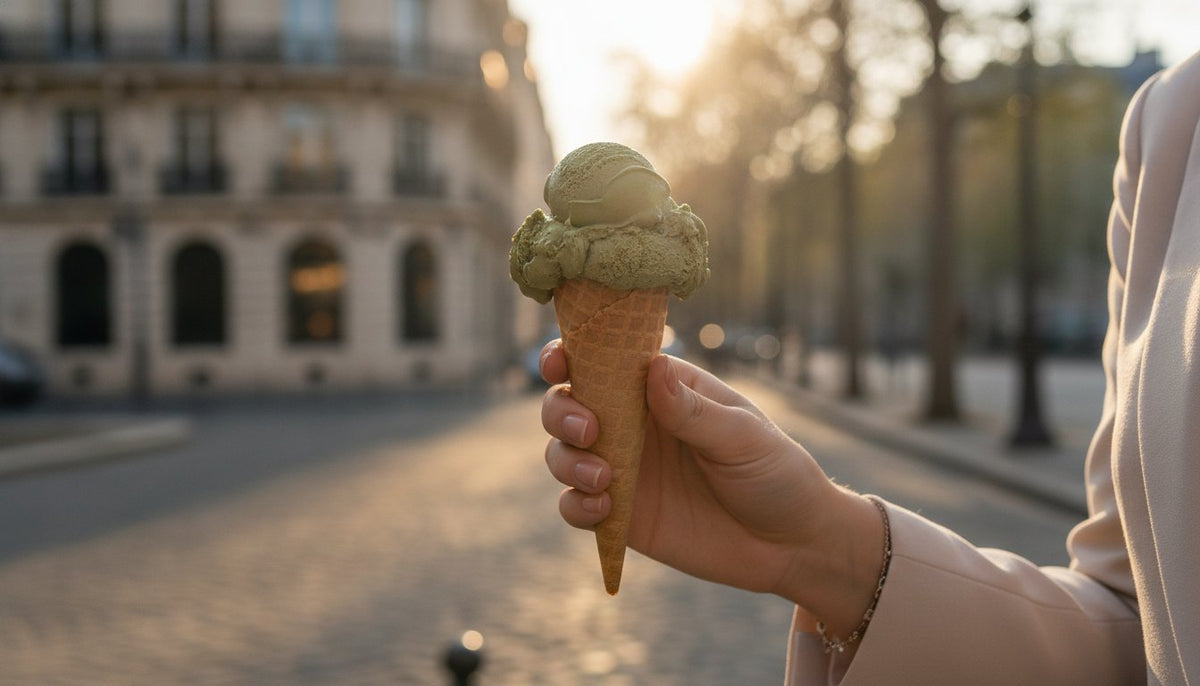
Nature possesses a discreet elegance, never flashy. An authentic pistachio, from pure grinding, displays shades of brown or earthy green. If you encounter a fluorescent emerald green, you are facing synthetic colorants. Similarly, a strawberry processed at full ripeness naturally turns a dark red, almost burgundy, far from the artificial pink of mass productions. Vanilla, on the other hand, must imperatively reveal its black specks, remnants of the pod infused patiently in milk. Transparency is a cardinal virtue. A detailed list of ingredients and allergens must be visible and accessible, testifying to impeccable manufacturing ethics.
Open Tubs vs. Pozzetti: The Preservation Debate
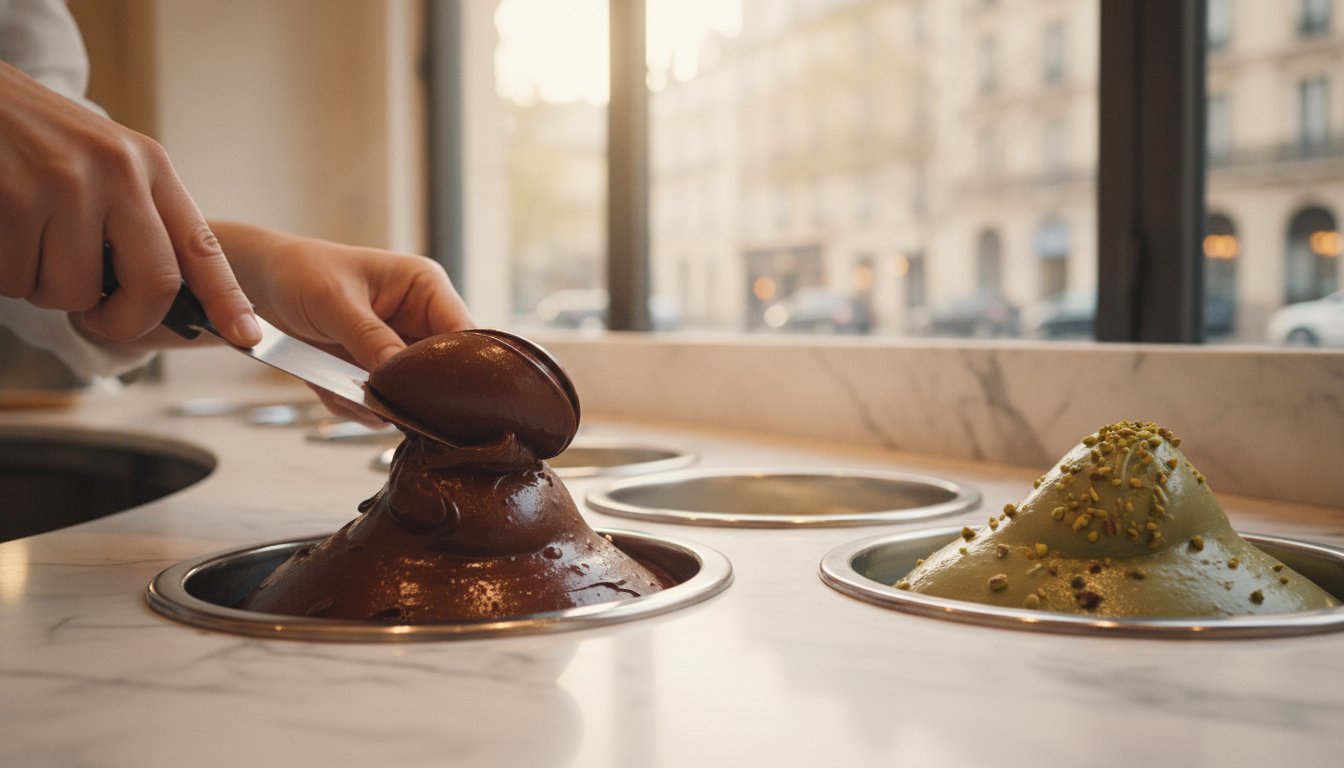
The pinnacle of refinement lies in "pozzetti." These cylindrical, recessed tubs protected by stainless steel lids are the guardians of the temple. They isolate the creation from its natural enemies: air, light, and temperature variations. Protected from oxidation, the ice cream retains its original creaminess and the subtlety of its most fragile aromas. While open tubs allow admiration of textures, they require extremely rapid turnover to prevent the formation of unpleasant ice crystals. Serving with a spatula or traditional spoon, executed with precise gestures, completes this staging of excellence. To discover this technical rigor combined with Sicilian passion, explore the artisanal ice cream and sorbet tubs from our establishment, where every visual nuance reflects an uncompromising selection.
Choosing an ice cream maker is an act of trust. An artisan who prioritizes the protection of their products in pozzetti rather than their spectacular display proves that taste outweighs appearance. It is this pursuit of invisible perfection that distinguishes the expert from the illusionist.
Sensory Analysis: How to Taste Like an Expert
Tasting is a ritual. A sensory immersion where every detail matters. After analyzing the visual cues in the display case, the final verdict belongs to the palate. Knowing how to choose an artisanal ice cream maker requires particular attention to the duality between lightness and intensity. An exceptional creation must offer immediate creaminess. It should coat the tongue elegantly, without ever leaving that greasy film sensation characteristic of second-rate raw materials. The serving temperature is also revealing. Ice cream served too cold numbs the taste buds, a technique often used to mask a lack of aromatic depth or an excess of sugar. The passionate artisan, on the other hand, seeks the ideal thermal equilibrium so that the flavors can fully unfold from the first contact.
The science of melting and overrun
Air is the invisible ingredient of the ice cream maker, but its excess betrays the industrialist. Ice cream with too much overrun lacks body. It melts instantly in the mouth, leaving only a sense of emptiness. Conversely, the presence of ice crystals is a sign of technical negligence or a break in the cold chain. The structure must remain smooth, dense, and homogeneous. This architectural perfection relies on the use of natural artisanal ice cream ingredients. The use of noble stabilizers, such as carob seed flour, allows for a silky texture while respecting the integrity of raw products. It is this surgical precision in dosing that defines the prestige of a house.
Length in Mouth and Aftertaste
Sugar balance is the ultimate challenge for the creator. It should never mask the main ingredient, but act as a subtle flavor enhancer. In a high-quality sorbet, the purity should be such that you have the illusion of biting into a freshly picked fruit. Aromatic persistence, or length in the mouth, is the true test. To test an artisan, turn to pistachio or hazelnut. These flavors require rigorous selection of dried fruits and perfect roasting mastery. A persistent, natural aftertaste, without artificial bitterness, confirms the excellence of the craftsmanship. It is here that the pride of the artisanal gesture meets the pure emotion of gastronomy.

Where to find excellence in Paris: The Saint-Germain-des-Prés district
Parisian elegance has a heart. Saint-Germain-des-Prés. To understand how to choose an artisanal ice cream maker, you must immerse yourself in this district where culinary tradition coexists with aesthetic avant-garde. The Left Bank remains the sanctuary of historical artisans, a stronghold where quality is not an option but an absolute given. Here, they don't just sell ice cream. They cultivate a heritage. Excellence is based on uncompromising selection, favoring short supply chains for fruits picked at full ripeness. This proximity to the terroir guarantees an intensity that mass production can never reproduce. At Angiolo, this quest for perfection comes to life under the guidance of a Sicilian ice cream chef. It is the sacred alliance between technical rigor and Mediterranean generosity. People come for the purity of a sorbet, but also for the assurance of an exceptional experience where every detail is meticulously weighed.
The charm of the neighborhood ice cream shop
Pushing open the door of a traditional shop is to forge a pact of loyalty. The artisan is not just a seller. They are the guardian of meticulous savoir-faire. Unlike globalized brands with standardized flavors, the master ice cream maker improvises. Their ephemeral creations are dictated by the daily market. A particularly juicy vine peach. An incredibly rare raspberry. The gustatory narrative constantly evolves with the seasons. It is this constant dialogue between the creator and their material that defines modern luxury: the exclusivity of the present moment.
Italian Gelato in Paris: A Quest for Purity
The distinction is subtle. Yet it is crucial. Italian gelato differs from French tradition by a creaminess achieved with less fat and limited overrun. The taste is direct. Without artifice. The thermal sensation here is paramount: the ice cream should not assault with polar cold, but caress the palate at a temperature allowing the aromas to fully unfold. For the enlightened amateur, knowing how to choose an artisanal ice cream maker means tracking down this original purity. It is necessary to scrutinize the artisanal gelato quality criteria to distinguish the real from the fake. Angiolo stands as an essential reference, transforming each tasting into a work of art. Whether for a frozen tiramisu or an affogato espresso, culinary precision is a promise kept. To enrich your tasting notebook, browse the best addresses in Paris.
Enhance your private receptions with our catering service for events, an immersion in frozen prestige in the heart of the capital.
Conclusion: Trust your senses to choose your ice cream maker
The pursuit of taste is an endless journey. Knowing how to choose an artisanal ice cream maker means first refusing compromise to embrace the exceptional. Throughout this guide, we have deciphered the codes of a world where technical precision meets pure emotion. A sober color palette. A creamy texture without fat. A short and legible ingredient list. These clues are unmistakable. They are the guardians of a quality that respects both your health and your taste buds. Choosing craftsmanship means treating yourself to a unique culinary signature, like that of our frozen tiramisu, where each layer tells a story of passion and rigor. Tasting is no longer just a sweet break. It becomes a true gastronomic experience, a moment of sensory distinction where the nobility of raw materials expresses itself without artifice.
Your checklist for your next visit
Savoir-faire is best appreciated with method. During your next gourmet stop, transform yourself into a taste expert thanks to these simple yet decisive reflexes. Observe the color: it must be a faithful reflection of nature, without artificial brilliance. Ask about the origin of the ingredients: an artisan proud of their work will accurately name their producers. Taste the texture: it must be silky, dense, and elegantly disappear without leaving a greasy film. Never hesitate to ask questions about the churning process or the balancing of sugars. To extend this quest for perfection in the privacy of your home, opt for artisanal ice cream tubs, fresh casings that preserve all the intensity of the original flavors.
Angiolo's commitment to your events
This culture of excellence is not limited to the shop. It extends to your most cherished moments. Bringing such high standards of quality to your private receptions is a sign of rare distinction. Whether for a prestigious wedding or a refined corporate seminar, choosing a high-end catering service transforms the atmosphere. Discover the authentic charm and elegance of a Parisian ice cream cart animation, where each cone is served with the precise gesture of a master artisan. It's the assurance of an animation that leaves a lasting impression through its purity and meticulous aesthetic. Contact us for a personalized tasting and let us guide you towards an exceptional experience where perfection is an absolute given.
Elevate your quest for frozen excellence
The pursuit of perfect taste is a discipline that demands as much passion as discernment. You now have the essential keys to distinguish authentic creation from simple mass-produced items. From the sober chromatic palette of the tubs to the precise creaminess of an unadulterated texture, every detail becomes a language. You now master the art of how to choose an artisanal ice cream maker by prioritizing ingredient transparency and rigorous traditional craftsmanship. Excellence is not told, it is experienced with every spoon.
In the heart of the Left Bank, Angiolo embodies this uncompromising vision. Under the aegis of an expert Sicilian ice cream chef, we transform 100% natural ingredients into ephemeral works of art. Recognized among the best addresses in Saint-Germain-des-Prés, our establishment invites you to an unprecedented sensory immersion. Discover the excellence of Angiolo artisanal ice creams in Paris and let the purity of flavors guide your steps towards an exceptional tasting experience. Luxury lies in the obviousness of quality. May your next rendezvous with ice cream be a celebration of high culinary precision.
Frequently Asked Questions about Frozen Excellence
What is the main difference between artisanal and industrial ice cream?
The difference lies in the creation of the base and the overrun rate. The artisan develops their own recipes from noble raw materials; while industry often uses powdered mixes. Industrial ice cream contains up to 50% air to artificially increase volume. True craftsmanship prioritizes density and intensity of flavors, offering a much deeper and more authentic sensory experience.
Why are some artisanal ice creams not displayed in open display cases?
The lack of direct exposure in pozzetti ensures superior preservation. These built-in cylindrical containers protect creations from oxidation, light, and temperature variations. This method preserves the original creaminess and the subtlety of the most delicate aromas. It is a technical choice that prioritizes taste quality over visual presentation, guaranteeing a consistently perfect tasting experience, far from external aggressions.
How to tell if a sorbet is truly made from fresh fruit?
An authentic sorbet offers the illusion of biting directly into a ripe fruit. The aromatic persistence must be intense and natural, without a chemical aftertaste. The texture should be smooth, without excessive ice crystals. Also, observe seasonality: an excellent artisan will not offer strawberry sorbet in the middle of winter. They always prioritize short supply chains and the ripeness of harvests to guarantee an explosion of flavors.
Does the presence of stabilizers mean that the ice cream is not artisanal?
No, natural stabilizers are essential for maintaining a silky texture. The artisan ice cream maker uses noble ingredients such as carob bean gum or guar gum. These natural components bind water and fat molecules without altering the taste. They differ radically from industrial chemical additives designed to artificially extend the product's shelf life at the expense of purity and health.
Why is the color of pistachio ice cream an indicator of quality?
Color is the first indicator of ingredient integrity. True pistachio, from pure grinding, shows brown hues or a discreet earthy green. A brilliant emerald green systematically betrays the use of synthetic colorants. To know how to choose an artisanal ice cream maker, rely on this chromatic sobriety. It guarantees the absence of artificiality and respect for exceptional raw materials, ensuring a taste experience faithful to the origin.
Is an ice cream maker who offers too many flavors suspicious?
Too extensive a menu can indeed arouse suspicion. Artisanal production requires a long time and meticulous precision for each recipe. A limited choice, often restricted to about twenty flavors, indicates daily production and rapid stock rotation. This allows the artisan to focus on the excellence of each creation. They adapt to fresh fruit arrivals from the market to offer absolute freshness.
What is the ideal temperature to enjoy artisanal ice cream?
The ideal serving temperature is between -12°C and -15°C. Ice cream served too cold numbs the taste buds and masks the complexity of flavors. At this precise temperature, the texture is perfectly creamy, and the aromas can fully bloom on the palate. It is this subtle thermal balance that allows you to savor all the nobility of artisanal creams and the vivacity of sorbets during your tasting.
Can you find artisanal ice cream without chemical additives in Paris?
Absolutely, Paris is home to prestigious establishments dedicated to absolute purity. At Angiolo, we banish all chemical additives to only sublimate the raw product. Our Sicilian chef ice cream maker ensures that each creation is an ode to nature. By choosing specialized addresses in Saint-Germain-des-Prés, you gain access to high culinary precision where the demands of preparation meet the fluidity of product access.