How many liters of ice cream for 100 people? The calculation guide
The number of guests is not enough to determine the quantity of ice cream: everything depends on the dessert's place in the menu. To know how many liters of ice cream to plan for 100 people, distinguish between a tasting as a complement to other treats and a frozen dessert served on its own. As a benchmark, a hypothetical portion of 125 ml per person represents 12.5 liters. If the ice cream is the main dessert, plan for about 20 to 24 liters instead.
These volumes are calculation scenarios, not universal standards. A generous bowl, a buffet where everyone serves themselves, or a reception with several desserts do not call for the same portion. The menu, the service time, and the chosen format—individual tubs or a cart—vary the estimate.
This guide helps you establish a clear calculation, then adjust it to your Parisian reception. You will discover how to evaluate portions according to the context and choose an appropriate service, from artisanal ice cream and sorbet tubs to cart service, to combine precision of quantities with the pleasure of tasting.
Key Points
- To determine how many liters of ice cream for 100 people, multiply the number of planned portions by the volume chosen for each.
- Adapt the portion to the place of the dessert in the menu: main dessert, tasting, or assortment of treats.
- Choose between individual tubs, a shared buffet, and a cart according to the desired pace and experience for your reception.
- Add a margin only if the service format and planned usage justify it.
- In Paris, artisanal ice creams and sorbets can make up a refined catering service, based on a approach that follows HACCP standards.
How many liters of ice cream should you plan for 100 people? The calculation principle
To estimate how many liters of ice cream for 100 people, multiply the number of planned portions by the volume of each portion. The number of guests is therefore not enough to fix the quantity: a small tasting and a bowl served as the main dessert do not require the same volume.
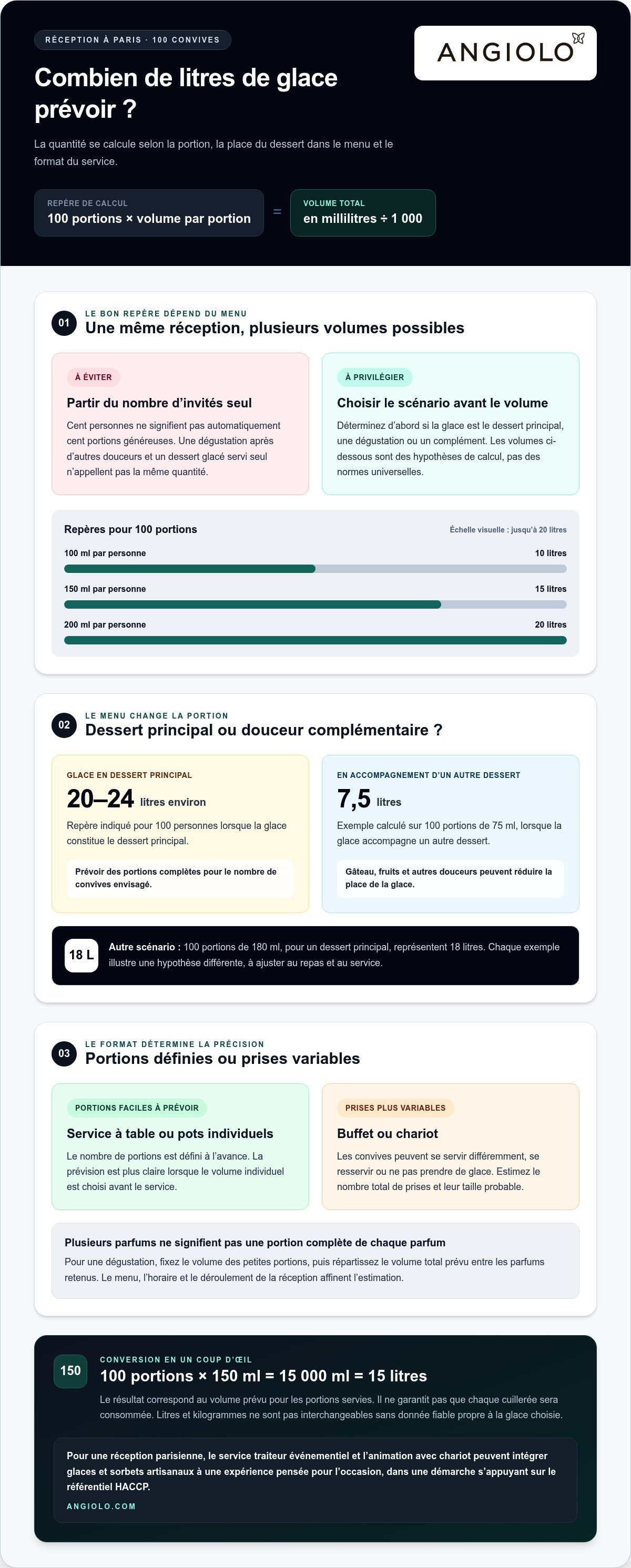
Calculation rule: total liters = planned portions × volume per portion. You can convert the portion volume to liters before multiplying, or do the calculation in milliliters and divide the total by 1,000. The result gives the volume planned for the service. Then adjust it according to the menu and the reception format.
What quantity per person should you use for an estimate?
The following volumes are calculation scenarios, not regulatory portions. For 100 guests, an assumption of 100 ml per person gives 10 liters, 150 ml gives 15 liters, and 200 ml gives 20 liters. These benchmarks allow you to compare several hypotheses before choosing the one that corresponds to your reception.
The choice depends mainly on the role of the dessert and how it will be served. An individual portion defined in advance makes planning easier. At a buffet, the quantities taken are more variable. The menu, other treats, and the desired experience will help you choose a consistent reference portion.
How to convert portions to liters without making a mistake?
With a 150 ml portion, the calculation is direct: 100 portions × 150 ml = 15,000 ml, or 15 liters. This figure corresponds to the volume planned for the portions served, and not necessarily the quantity consumed to the last spoonful. There may be ice cream left over, while an all-you-can-eat service makes portions less predictable.
Also distinguish between the served volume and the purchased or ordered volume. The first corresponds to the sum of the calculated portions; the second refers to the volume of product planned for the service. To move from one to the other, take into account the chosen presentation and packaging. The total volume of portions does not automatically correspond to the quantity that will actually be enjoyed.
Finally, liters and kilograms are not interchangeable by default. Weight depends on the product and its composition. Without reliable data specific to the chosen ice cream, an automatic conversion risks distorting the estimate. Ice cream and sorbet are different preparations; for an initial calculation, think in terms of portion volume.
How do the menu and service time change the necessary liters?
Start by determining the place of the ice cream in the meal. Served as the main dessert, it must cover the number of full portions envisaged. After a hearty meal or alongside other treats, it becomes a complementary note, usually served in more modest quantities. The menu therefore counts as much as the number of guests.
Ice cream as main dessert or after a meal: what is the difference?
To illustrate the gap, imagine 100 portions of 180 ml when ice cream is the main dessert: this represents 18 liters. If it accompanies another dessert, an assumption of 75 ml per person gives 7.5 liters. These examples serve to compare two scenarios, not to fix a portion valid for all receptions.
The composition of the menu refines the choice. A cake, fruit, or other desserts can reduce the place given to the ice cream, while a unique frozen proposition calls for full portions. The reception schedule also counts: a dessert served at the table at the end of the meal is planned differently from a tasting at another time, where some guests may not help themselves.
Buffet, tasting, or dessert served at the table: what adjustments?
At the table, the number of portions is generally defined in advance. At a buffet, habits vary: some guests may go back for seconds, while others take a small quantity or skip it. In that case, estimate the total number of servings and their likely size instead of assuming an identical portion for everyone.
For a tasting, first fix the volume of each small portion, then the number of flavors offered. Several flavors can encourage guests to taste different varieties, without needing to plan a full portion of each flavor per person. Instead, estimate the total volume likely to be served, then distribute it among the chosen tastes.
Adjust your estimate to the menu, the time, the flow of the reception, and the expected habits of your guests. In Paris, event catering service and cart animation make it possible to integrate artisanal ice creams and sorbets into a service experience designed for the occasion.
Ice cream or sorbet for 100 people: comparing service formats
The chosen format determines how to distribute the volume. One hundred individual tubs make it clear to plan the number of portions. A buffet or a cart requires an estimate that takes into account less uniform servings. To know how many liters of ice cream to plan for 100 people, therefore, associate the calculation with the service mode and the chosen desserts.
Ice cream and sorbet offer different sensations, from creaminess to fruity and fresh notes. Portions are not necessarily identical: recipe, container, and place of the dessert in the menu influence the volume served. The diversity of flavors can also encourage guests to taste several flavors, without allowing for a universal ratio to be established. Base your calculation instead on the total volume planned for the service.
Individual tubs or buffet: which format to favor?
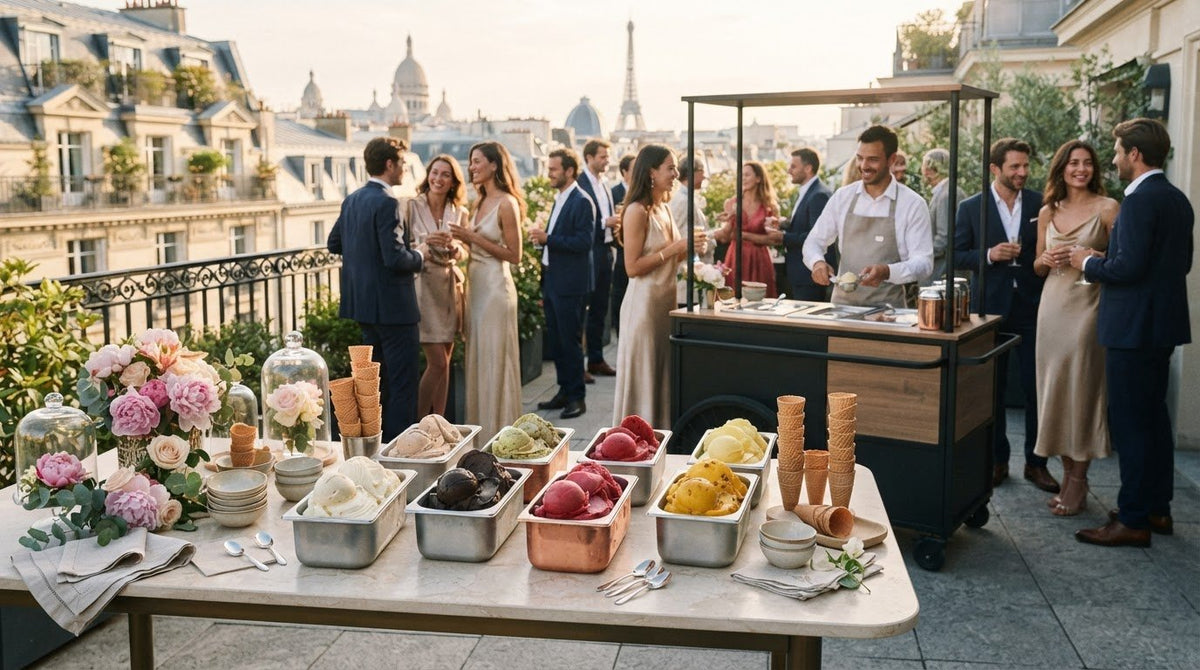
Individual tubs facilitate the counting of portions and are suitable for a reception where the service follows the rhythm of the meal. The shared buffet offers more freedom: everyone chooses their flavor and adjusts the quantity according to their desire. In return, the portions and number of servings may vary. To choose, consider the duration of the service, the movement of guests, and the desired atmosphere, from a controlled tasting to a freer moment.
In both formats, the selection of flavors contributes to the experience. An assortment of artisanal ice creams and sorbets makes creamy richness and fruity freshness dialogue. You do not, however, need to plan a full portion of each flavor for each person: distribute the estimated volume among the chosen flavors.
When to choose an ice cream cart animation?
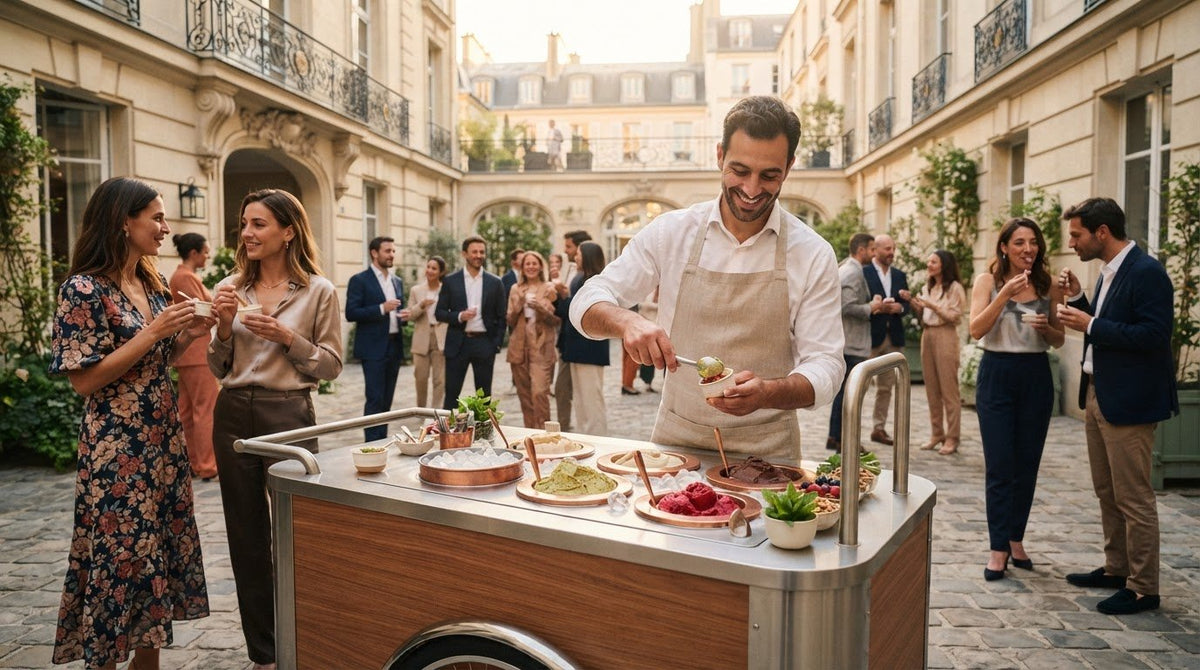
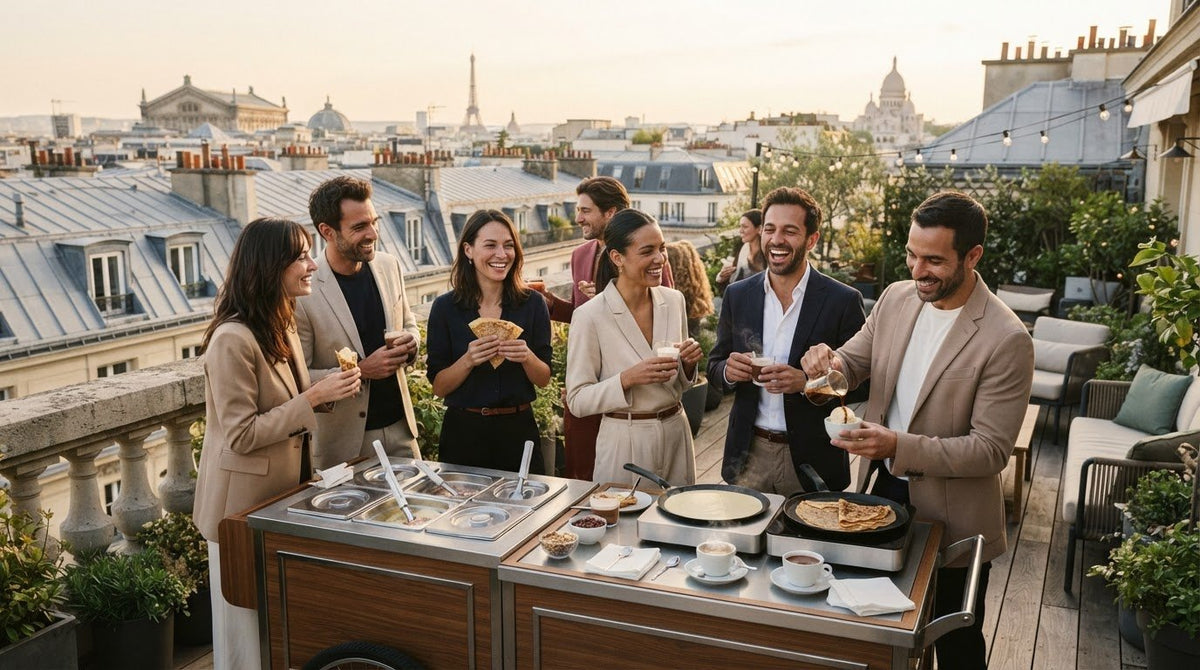
The cart is suitable when the service itself needs to become a highlight of the reception. It attracts attention, creates a meeting point, and transforms the choice of flavors into a gourmet animation. Angiolo offers an ice cream cart animation for events. In Paris, this format combines artisanal expertise with elegant presentation.
To estimate the volume, start from the envisaged portions, then take into account the number of flavors offered and how guests will follow each other to the cart. A reception where ice cream is the main dessert is not planned like a simple tasting. The article dedicated to ice cream cart animation in Paris presents this event format in more detail.
Preparing ice cream service for 100 guests: practical method
A reliable estimate relies on explicit hypotheses, not a number chosen at random. Proceed in this order: define the place of the ice cream in the menu, set a reference portion, estimate how many guests will have some, then calculate the total volume. This method makes your calculation readable and facilitates adjustments if the service format changes.
What information to gather before setting the volume?
Note the number of expected guests and the role of the frozen dessert: main dessert, complement after a meal, or tasting. Add other planned desserts, the service format, and the rhythm of the reception. These elements will help you establish a portion consistent with the desired experience.
For example, if you provisionally retain 120 ml per portion and estimate that the 100 guests will each have one, the calculation gives 12 liters. This is a hypothesis to revise if the ice cream accompanies other treats or if the service is done as a buffet. To keep a clear estimate, note the number of portions, their volume, and any added margin, with the reason for this adjustment.
How to limit quantity errors on the day of the event?
Do not automatically count a full portion per guest if the ice cream is shared or offered among several desserts. Conversely, portions defined in advance and buffet service are not calculated in the same way. Plan quantities compatible with containers and the presentation method so that your estimate corresponds to the actual service. For large outdoor events, the preservation of such volumes also requires rigorous refrigeration logistics, much like the freezer trailers offered by kcfrostwagon.com.
If several flavors are offered, distribute the projected volume among them rather than planning an entire portion of each flavor per guest. The distribution can reflect the menu and the planned selection, without applying a universal ratio. A margin is justified if a concrete element motivates it, for example, the freedom to go back for more at the buffet or portions likely to vary. Indicate it separately from the basic calculation so that the estimate remains transparent.
To articulate quantity, menu, and service organization, the frozen dessert catering service in Paris accompanies the preparation of a made-to-measure reception, with artisanal know-how and quality ice creams and sorbets.
Choosing an ice cream service in Paris for a 100-person reception
Once your estimate is established, link it to how you wish to welcome your guests. To determine how many liters of ice cream for 100 people, the calculation gives a benchmark; the format gives it its concrete form. Individual tubs, buffet, and cart do not distribute portions in the same way and do not create the same atmosphere.
Which service to choose according to the desired experience?
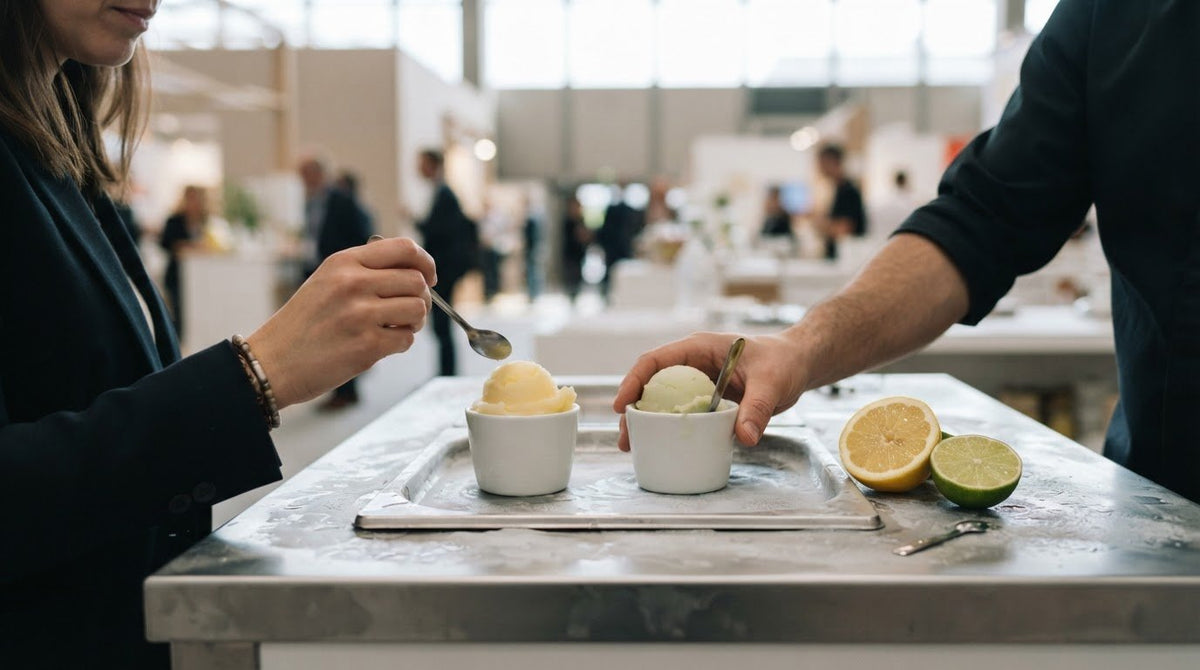
Artisanal ice cream and sorbet tubs are suitable for a service organized around individual portions. They facilitate the planning of the number of desserts and offer each guest a defined format. Discover Angiolo's event ice cream services, which include artisanal tubs and event catering.
With the cart, the act of service becomes a highlight of the reception. Guests choose from the flavors offered, and this moment can turn into a gourmet animation. The cart suits an event where you wish to create a meeting point and offer a more lively experience than a dessert simply placed at the table. The volume to plan depends on the envisaged portions and the flow of the service.
Artisanal ice creams and sorbets bring complementary profiles to the menu: the creaminess of the former, the fruity freshness of the latter. Choose them in agreement with other desserts to compose a harmonious end to the meal, without multiplying the portions by flavor.
How to move from estimate to a made-to-measure experience?
To prepare your reception, gather four benchmarks: the number of guests, the place of the frozen dessert in the menu, the retained portion volume, and the service format. Also specify other desserts and the desired rhythm. These elements give a clear basis for adapting the estimate to your project, rather than applying the same quantity to all receptions.
In Paris, artisanal know-how is expressed in a presentation designed for the elegance of your event, in tubs or with cart animation. Angiolo's approach is based on the HACCP reference system, a method of hazard analysis and control of critical points in terms of food safety.
To give your reception an ice cream signature in harmony with its menu and ambiance, discover Angiolo's event ice cream services.
Compose an ice cream service tailored to your reception
To know how many liters of ice cream for 100 people to plan, start from the volume chosen for each portion and the number of guests likely to help themselves. The menu remains decisive: an ice cream served as the main dessert is not calculated like a tasting after a meal or among several treats.
The format then refines the estimate. Individual tubs allow you to plan defined portions; a buffet or cart allows more freedom and can lead to variable servings. Note your hypotheses, distribute the volume among the chosen flavors, and only add a margin if the planned progress justifies it.
In Paris, artisanal ice creams and sorbets bring a touch of freshness and know-how to your reception. The purity of the ingredients and the quality of the preparations give these frozen desserts their unique character. Angiolo's approach is also based on the HACCP reference system.
To imagine a service in agreement with your menu and the atmosphere of your event, discover Angiolo's event ice cream services. A clear calculation is the first step towards a gourmet moment, elegant and thought out for your guests.
Frequently asked questions about ice cream quantities
How many liters of ice cream should you plan for 100 people?
The volume depends on the planned portions and the place of the dessert in the menu. To estimate how many liters of ice cream for 100 people, multiply the number of portions by their volume. With an assumption of 150 ml per portion and 100 portions, the calculation gives 15 liters. Adjust this benchmark according to other desserts and the service format.
How much ice cream to plan per person for a dessert?
First, define the portion you wish to serve, then multiply it by the number of concerned guests. As calculation hypotheses, 100 ml per person for 100 guests represents 10 liters, 150 ml represents 15, and 200 ml, 20. These volumes are not standards: the size of the portion depends on the menu, the service time, and the retained format.
How to calculate the liters of ice cream for a 100-guest buffet?
For a 100-guest buffet, start by determining if the ice cream is the main dessert or one of several proposals. Then retain a hypothetical portion and multiply its volume by the number of envisaged portions. As guests can go back for seconds and choose different flavors, do not assume everyone will take the same quantity. Adjust the calculation to the menu and the progress of the buffet.
Should you plan as much sorbet as ice cream?
No, it is not necessary to provide identical volumes. The distribution depends on the chosen flavors, the menu, and the space allocated to each dessert. Estimate the volume of sorbet and ice cream separately, then add them together to get the total. A fixed distribution alone cannot take into account guest preferences or the method of service.
Do liters of ice cream correspond to the same weight in kilograms?
No. The liter measures volume, while the kilogram measures mass; their equivalence depends on the product. Composition and texture can influence the weight corresponding to a given volume. For planning an event, therefore, base your calculation on the volume of the portions served. Only convert to kilograms if you have reliable data specific to the ice cream in question.
How do you adjust the amount of ice cream if other desserts are planned?
If the ice cream accompanies a cake or other sweets, calculate a complementary portion rather than a full portion for each guest. Choose a hypothetical volume, then multiply it by the number of people likely to help themselves. Re-evaluate this estimate based on the menu and the flow of the meal. The result remains a preparation scenario, not a guaranteed quantity for all events.
Is an ice cream cart station suitable for a reception of 100 people?
A cart station can make the service a gourmet and visible moment of the reception. To estimate the volume, start with the number of guests involved and the intended portion size, then take other desserts into account. In Paris, Angiolo offers an ice cream cart station as well as event catering services. Plan the chosen format and the quantity calculations together.