Best mango sorbet: artisanal guide in Paris
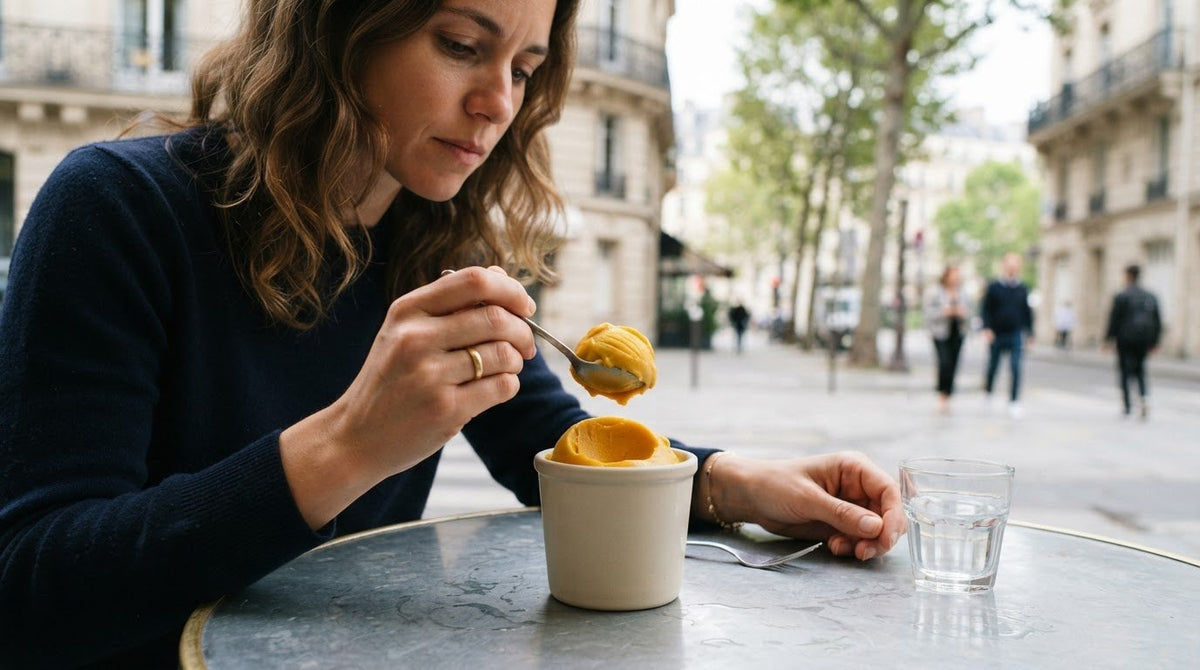
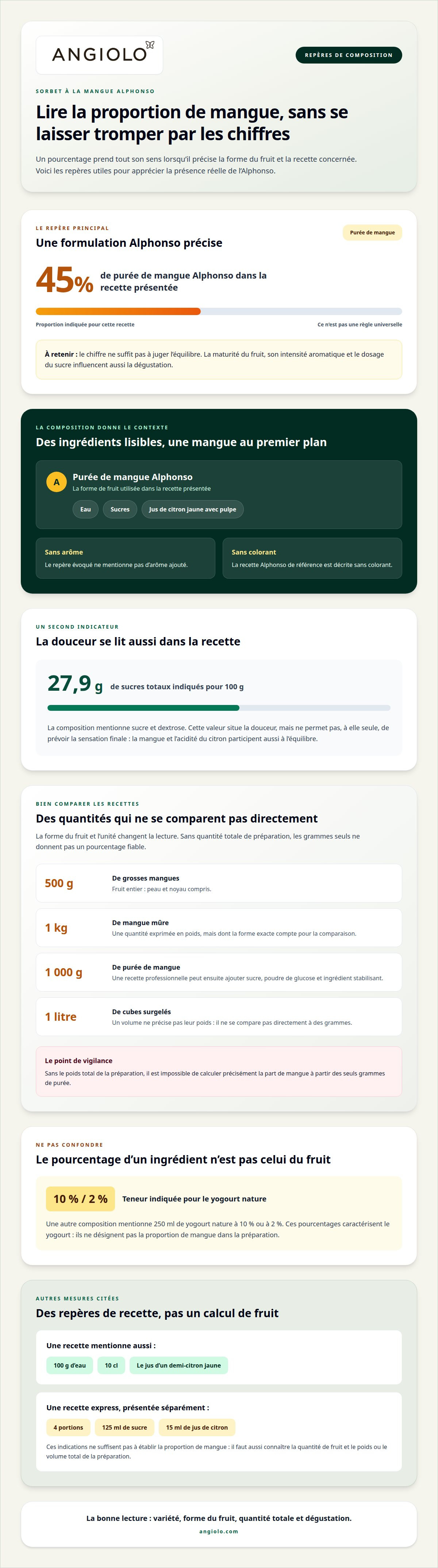
The Alphonso variety is not enough to make a great sorbet: the proportion of fruit and the clarity of the recipe matter just as much. To recognize the best mango sorbet, look for a concrete benchmark: an Alphonso recipe containing 45% mango puree, without flavoring or coloring.
The mango should express itself fully, with a broad sweetness and a clean texture, without being masked by sugar. The composition helps to appreciate this purity: Alphonso mango puree, water, sugars, and lemon juice with pulp.
This guide will help you interpret the proportion of mango, examine the ingredients, and distinguish an artisanal sorbet from a preparation where the fruit fades into the background. You will also discover the manufacturing steps that preserve the aromatic intensity of the Alphonso, so you can choose a highly precise sorbet in Paris, both bright and balanced.
Key takeaways
- Assess the fruit's actual place in the recipe and how its flavor remains perceptible during tasting.
- Learn to read a composition to distinguish essential ingredients from additions that alter the sorbet's profile.
- For a vegan diet or in case of allergies, do not rely on the appearance of the sorbet: the composition and manufacturing conditions matter.
- Identify the artisanal steps that contribute to a smooth texture and well-preserved mango aromas.
- Discover how an ice cream stand can add a gourmet dimension to a brand activation or a trade show.
Proportion of mango in the recipe
- Locate the mango in the list of ingredients. Its place indicates its relative importance, but does not always reveal its percentage. An Alphonso mango sorbet recipe mentions 45% mango puree. This benchmark concerns a precise formulation, not a universal rule. To choose the best mango sorbet, consider this rate along with the variety and taste of the fruit.
- Compare quantities expressed in the same unit. Recipes sometimes indicate 500 g of large mangoes, 1 kg of ripe mango, or 1,000 g of puree. Another uses 1 liter of slightly thawed frozen cubes. This data cannot be compared directly: the volume of the cubes does not specify their weight, while the whole mango includes the skin and pit.
- Distinguish whole fruit from puree. A professional recipe may start with 1,000 g of puree, then add sugar, glucose powder, and an ingredient that helps stabilize the texture. To assess the proportion, you need to know the total quantity of the preparation. Without this total, grams alone do not allow you to calculate a reliable percentage or precisely distinguish between two recipes.
- Interpret the figure according to the variety. In an Alphonso sorbet advertised at 45% puree, this rate describes the share of mango in this recipe. The variety also has its own aromatic profile. A high proportion is therefore not enough to judge the balance: the ripeness of the fruit, aromatic intensity, and sugar dosage together influence the perception on the palate.
- Link the percentage to the tasting. The fruit must remain identifiable, without being reduced to a uniform sweetness. The best mango sorbet is not recognized by an isolated figure, but by the balance between the proportion of fruit, freshness, and texture. Compare the variety and form of the fruit used, then check that the mango expresses itself clearly on the palate.
The other ingredients provide useful context, without replacing the indication of the quantity of mango. The recipe uses 100 g of water, or 10 cl, and the juice of half a yellow lemon. These elements appear in the composition, but their presence does not, on its own, allow you to deduce the share of the fruit. To compare recipes, note the quantities as they are indicated and check to which preparation they relate. The list can thus enlighten the overall balance while leaving the percentage of mango unknown when the total quantity is not provided. Therefore, avoid transforming an impression of a fruity recipe into a numbered proportion without sufficient data.
The express mango sorbet recipe makes 4 servings. It contains 125 milliliters of sugar and 15 milliliters of lemon juice. These measurements provide information about the ingredients associated with the mango, but they do not constitute a calculation of its proportion: you must also know the quantity of mango and the weight or total volume of the preparation. Lemon juice may be mentioned in a different form depending on the recipe, such as half a yellow lemon or a quantity measured in milliliters. Keep this distinction in mind when reading the ingredients, and do not assume that these indications necessarily describe a single formulation.
Another composition mentions 250 milliliters of plain yogurt at 10% or 2%. This specification concerns the yogurt, not the share of mango in the sorbet. It reminds us that a percentage listed near an ingredient may refer to a characteristic of that ingredient rather than the proportion of the fruit in the whole. To judge the real place of the mango, look for a quantity of fruit relative to the complete preparation. If the recipe only gives quantities of complementary ingredients, they provide reading benchmarks, but are not enough to establish a reliable percentage or directly compare the richness in mango.
What ingredients does an artisanal ice cream maker select to make a good mango sorbet?
- Identify the form of mango used. In the Alphonso recipe presented here, the fruit enters the composition in the form of puree. It gives the mixture a homogeneous base and carries its aromas. The mention of the variety brings more precise information than the word "mango" alone, without guaranteeing the balance of the tasting on its own.
- Examine the sugars named in the composition. The recipe combines sugar and dextrose, two ingredients that contribute to the sweet taste of the sorbet. The total quantity of sugars indicated is 27.9 g per 100 g. This benchmark helps to situate the sweetness, but does not reveal, on its own, the final perception: the intensity of the mango and the acidity of the lemon also contribute to the balance.
- Locate the yellow lemon with pulp. In the Alphonso sorbet, it complements the mango with a tangy note. This acidity can balance the sweetness of the fruits and make their aromas clearer. Thus, observe the coherence of the ingredients: the lemon must support the fruity presence, without diverting the tasting toward a different dominant flavor.
- Understand the role of emulsifiers and stabilizers. These ingredients appear in the composition of the Alphonso sorbet. Emulsifiers help to mix ingredients that separate with difficulty, while stabilizers help preserve a homogeneous texture. The list does not specify their exact nature. Assess them with the rest of the composition, rather than making them an isolated indicator of quality. During tasting, the expression of the fruit remains essential.
- Check the mention of flavorings and colorings. The Alphonso sorbet is presented without flavoring or coloring. To know what contributes to the taste and appearance, read the composition as a whole: puree, sugars, lemon, and formulation ingredients must form a clear recipe, faithful to the mango.
Is mango sorbet suitable for people with allergies or following a vegan diet?
- Distinguish the recipe from the manufacturing conditions. The composition of a sorbet with mango includes mango puree, water, sugar, dextrose, and yellow lemon juice with pulp. It also mentions emulsifiers and stabilizers. This list allows you to examine the incorporated ingredients, but does not describe on its own the environment where the sorbet is produced.
- Do not deduce the vegan nature from the word "sorbet" alone. The list of ingredients cited does not mention milk or eggs. However, it does not specify the origin of the emulsifiers and stabilizers. A composition that does not explicitly cite certain animal products therefore does not, on its own, constitute a vegan certification.
- Consider the allergens present in the workshop. The workshop where the mango sorbet is made also uses peanuts, tree nuts, milk, eggs, soy, sesame, and gluten. Another indication signals the use of sulfites. These mentions concern the manufacturing environment, not necessarily the recipe itself. They matter for people sensitive to traces or cross-contamination.
- Assess the risk according to your personal situation. In case of a milk allergy, take into account its use in the workshop, even if it does not appear in the cited composition. The same principle applies to eggs, peanuts, and tree nuts. For a vegan diet, the displayed recipe does not guarantee on its own the absence of contact with ingredients of animal origin during manufacturing.
- Read the two pieces of information separately. For a mango sorbet, distinguish the declared ingredients from the allergens used in the workshop. This avoids drawing a conclusion solely from the fruity aspect or the category of the dessert. In case of a severe allergy, take the presence of an allergen in the production environment particularly seriously.
Artisanal sorbet
- Observe the preparation of the fruit. In an artisanal recipe, the fineness of the mango puree influences the mouthfeel. If the flesh retains fibers, passing it through a sieve allows you to remove them and refine the texture without erasing the character of the fruit. For a livelier expression, a recipe can also incorporate lime juice.
- Locate the balance of the syrup. A mango sorbet recipe provides 150 ml of water and 150 g of sugar to prepare the syrup. The water and sugar are brought to a boil, then the mixture cools. This base is then combined with the puree: its dosage contributes to the sweetness and the hold of the sorbet, without replacing the mango aromas.
- Prefer a mixture cooled before churning in the machine. The preparation is placed in the refrigerator until it is cold. This step precedes its passage in the ice cream machine, where churning accompanies the cold setting. A recipe given for about 1 liter allows you to understand the scale of a preparation, but the final volume depends on the formulation and the work of the ice cream maker.
- Link the churning time to the texture. A recipe indicates 30 to 40 minutes of churning in the machine. This duration is part of a process where the mixture cools while being churned. The desired result is a regular texture, easy to serve, which preserves a clear mango flavor. The timing does not replace the attention paid to the consistency.
- Consider storage after manufacturing. The Alphonso Mango sorbet must be stored at −18 °C. A recipe also recommends an airtight container before freezing. These indications concern the preservation of the product after its preparation. At the time of tasting, a well-worked texture and clear aromas allow you to appreciate the quality of the fruit and the precision of the artisanal gesture.
If the puree retains fibers, the recipe recommends passing it through a sieve to remove them. To prepare the sorbet, reduce the mango to a puree with the sugar and lemon juice, then add the yogurt and mix. The mango sorbet recipe uses 275 g of sugar, a quantity to distinguish from the sugar possibly intended for the syrup.
For this syrup, add the sugars to the water at 40 °C, then heat it to 85 °C to pasteurize the mixture, that is, to heat it to reduce microorganisms. The preparation of the syrup also consists of bringing the water and sugar to a boil, then letting it cool. Once cooled, it can be integrated into the fruity preparation before churning in the machine, ensuring a homogeneous mixture.
An ice cream stand for a brand activation in Paris, Nice, Cannes, or Monaco
- Link the tasting to the campaign message. In Paris, a product launch can be accompanied by a stand where ice creams become a meeting point. The choice of flavors, sorbets, and frozen desserts matches the intention of the event. A well-thought-out proposal creates a coherent experience, beyond a simple gourmet break.
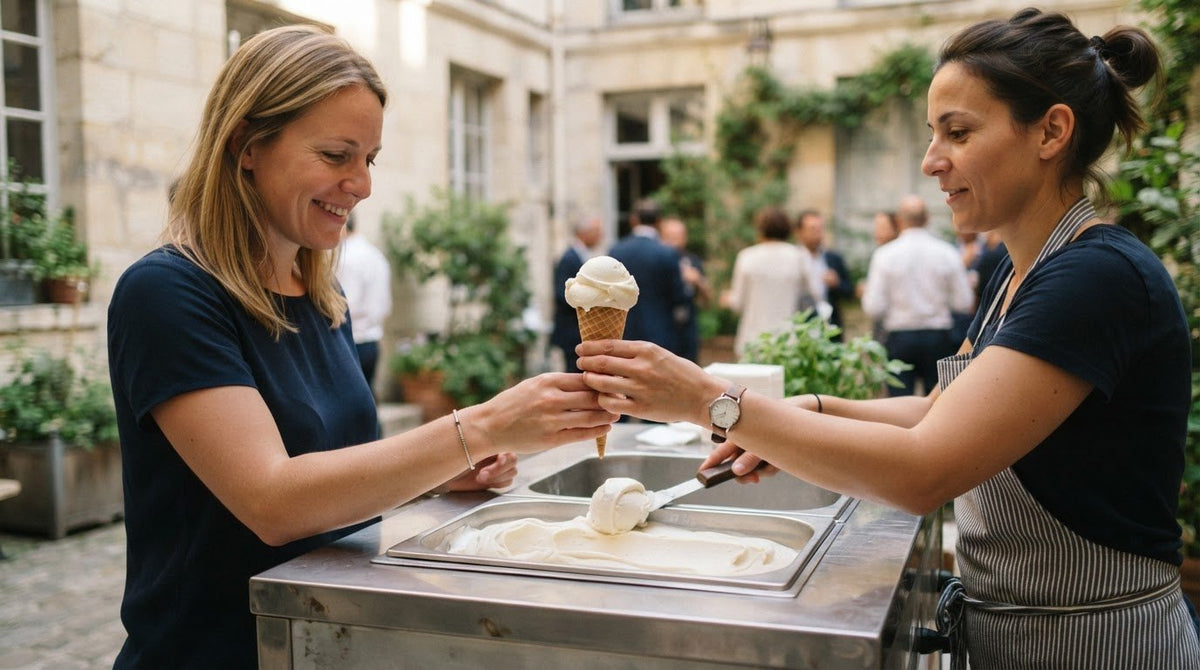
- Choose the format that serves the exchange. An animation with an ice cream cart makes the service visible and lively. In Nice, the cart can become a gathering place during a brand reception; in Monaco, it also integrates into a more intimate meeting. The event catering service allows you to place the ice creams in a broader proposal.
- Compose a selection adapted to the audience. A mango sorbet can bring a fruity and bright note to a summer activation in Cannes. Other artisanal ice cream cups or frozen desserts complete the tasting, according to the spirit of the brand and the profile of the guests. A carefully thought-out selection favors discovery without diverting attention from the event.
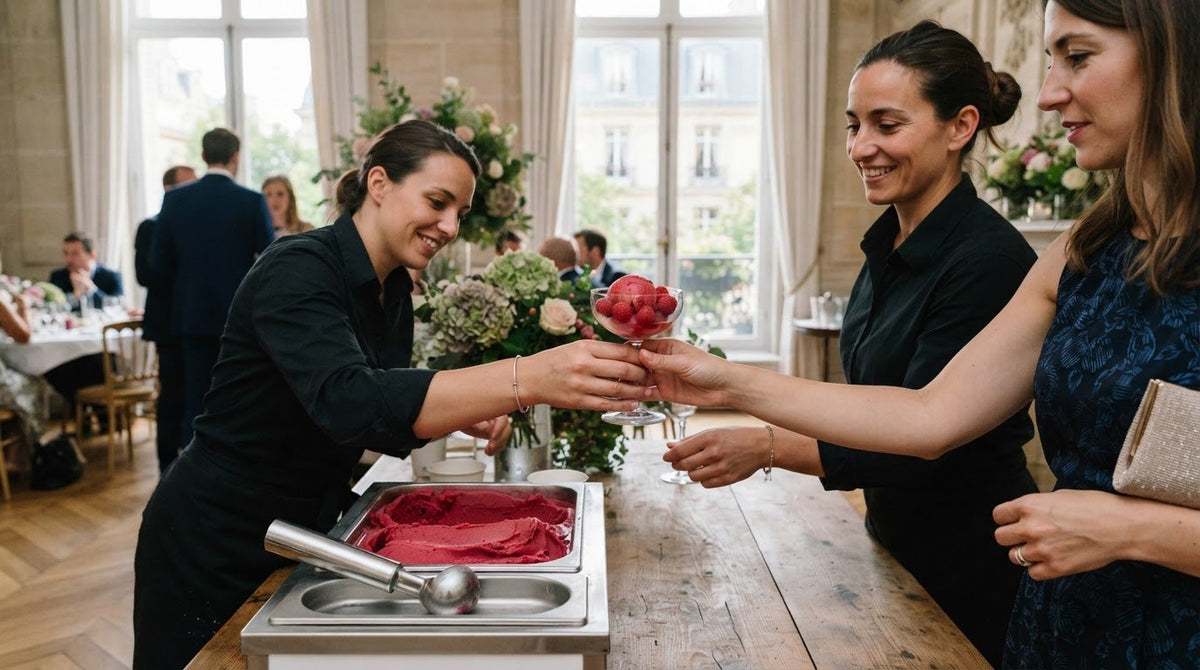
- Make the act of service a brand moment. With a cart, distribution becomes an animation: the guests approach, discover the flavors, and choose their tasting. In Paris as on the Côte d’Azur, this meeting time can extend the exchanges with the teams. The quality of the product and the attention paid to the service give the experience its distinctive character.
- Build a custom experience. To prepare an activation, define the tone of the brand, the reception context, and the place given to the tasting. These elements guide the format and the selection. In Nice, Cannes, Monaco, or Paris, an ice cream stand designed for the event brings a gourmet and elegant pause, conducive to exchanges.
An ice cream stand for a trade show
- Define the function of the stand. In a trade show in Paris, the stand can offer a gourmet break, welcome prospects, or extend a presentation. Link the tasting to the objective of your presence: introduce a product, favor exchanges, or receive your partners. This intention will guide the format and the selection.
- Choose a formula adapted to your space. An ice cream bar for trade shows creates a clearly identifiable tasting point. An animation with a cart brings a more mobile and visible presence. Choose according to the layout of the stand, the flow of visitors, and the place you wish to dedicate to the welcome.
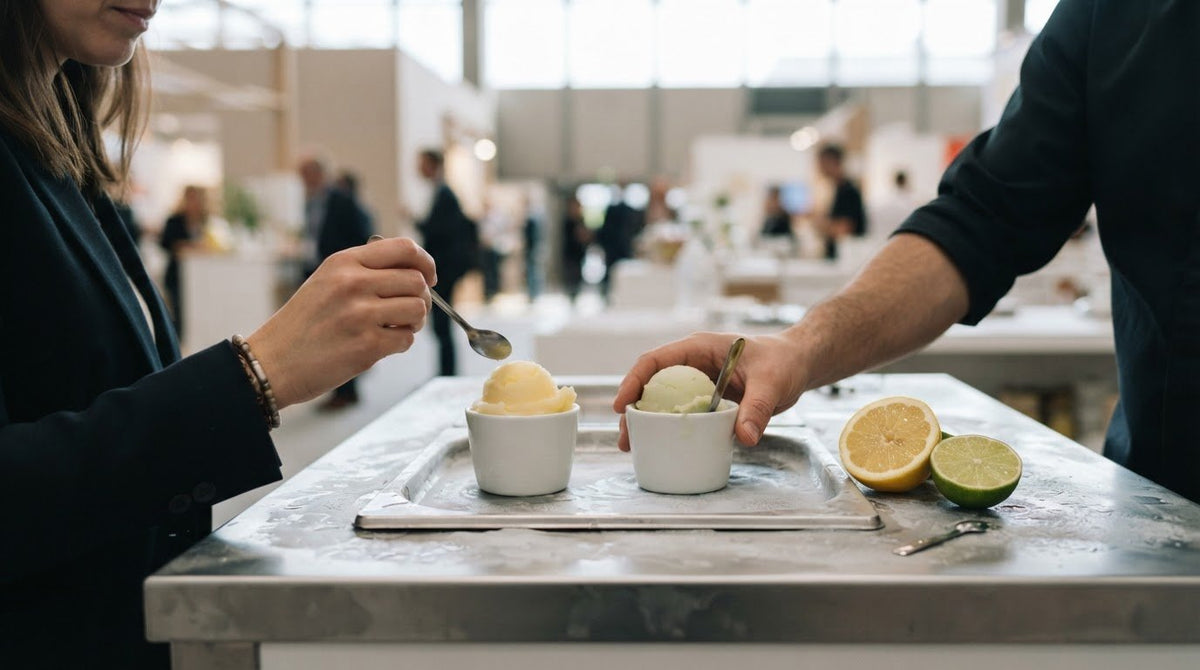
- Compose a selection that facilitates the choice. Artisanal ice cream and sorbet cups allow you to offer different gourmet expressions, from fruity to more generous. A mango sorbet can bring a lively and colorful note to a professional reception. Frozen desserts can complete the proposal when the tasting accompanies a time of welcome or meeting.
- Integrate the service into the rhythm of the show. A tasting can punctuate a presentation, accompany a conversation, or offer a break between two appointments. The event catering service allows you to integrate the ice creams into the welcome of your stand. Think about the path of the visitors, from their arrival to the choice of desserts, to preserve the fluidity of the exchanges.
- Align the experience with your brand identity. The presentation, the selection of flavors, and the role of the stand should form a cohesive whole that reflects your brand. Whether in Paris or another city, an offer tailored to the event transforms the tasting into a distinctive experience. The quality of the products and the attention paid to service reinforce this impression.
Angiolo: artisanal ice cream and sorbet cups
Angiolo offers artisanal ice cream and sorbet cups, as well as frozen desserts for gourmets and events. After assessing the role of fruit, the composition, and the texture, choose a format suited to your occasion: a shared tasting, a reception, or a professional meeting.
To appreciate a mango sorbet, examine the fruit variety, the stated proportion, the balance of sweetness, and the aromatic finesse. Alphonso refers to a specific variety, but is not enough to describe a recipe. The selection of ingredients and artisanal expertise contribute to the purity and expression of the fruit.
An event calls for a different presentation. An ice cream cart activation transforms service into an opportunity to meet guests, while catering service incorporates frozen desserts into the reception. Choose the format according to the occasion, the space, and the desired experience. In Paris, Nice, Cannes, or Monaco, this approach is suitable for an elegant reception, a brand activation, or a trade show.
To prepare your project, specify the context, the expected audience, and the role given to the tasting. These elements guide the choice between cups, a cart, or event service. A flavor preference or particular attention to ingredients can also guide your request.
Discuss your project with Angiolo and the frozen dessert format that best suits it.
Frequently asked questions about mango sorbet
What criteria help identify the best mango sorbet sold in France?
To choose the best mango sorbet, look for a clear fruit flavor, a smooth texture, and a sweetness that does not mask the tart notes. The list of ingredients reveals the role of mango and the simplicity of the recipe. When tasting, the sorbet should melt without leaving a pasty sensation or an artificial aftertaste. In Paris and elsewhere in France, also check the manufacturing method indicated by the artisan.
Which French brands offer artisanal mango sorbet?
Regarding mango sorbet specifically, the Angiolo range presented here does not include a mango product. Its sorbets notably include CAPRICE DE FRAISES, flavored with Mara des Bois strawberries, and CRISTAL CITRON ET YUZU. In Paris, Nice, Cannes, and Monaco, consult the ice cream shop's menu before choosing: the available flavors may vary. If you are looking for a different fruity composition, artisanal sorbet cups allow you to discover the creations on offer.